Tag Archives: art

Tips for Setting Up A Still Life

A flea market find, this silver teapot and sugar bowl cost less than $10.

A flea market find, this silver teapot and sugar bowl cost less than $10.

I just purchased this silver-plated teapot and sugar bowl at a flea market for $10.  It was heavily tarnished and wouldn’t be anything I would want to actually use, but it will make a great addition to my arsenal of items for still life set ups.  To check out more recommendations, from how to set up, objects to consider, to my large cupboard of items, visit my page for Tips for Setting Up A Still Life.

Sketching in New York

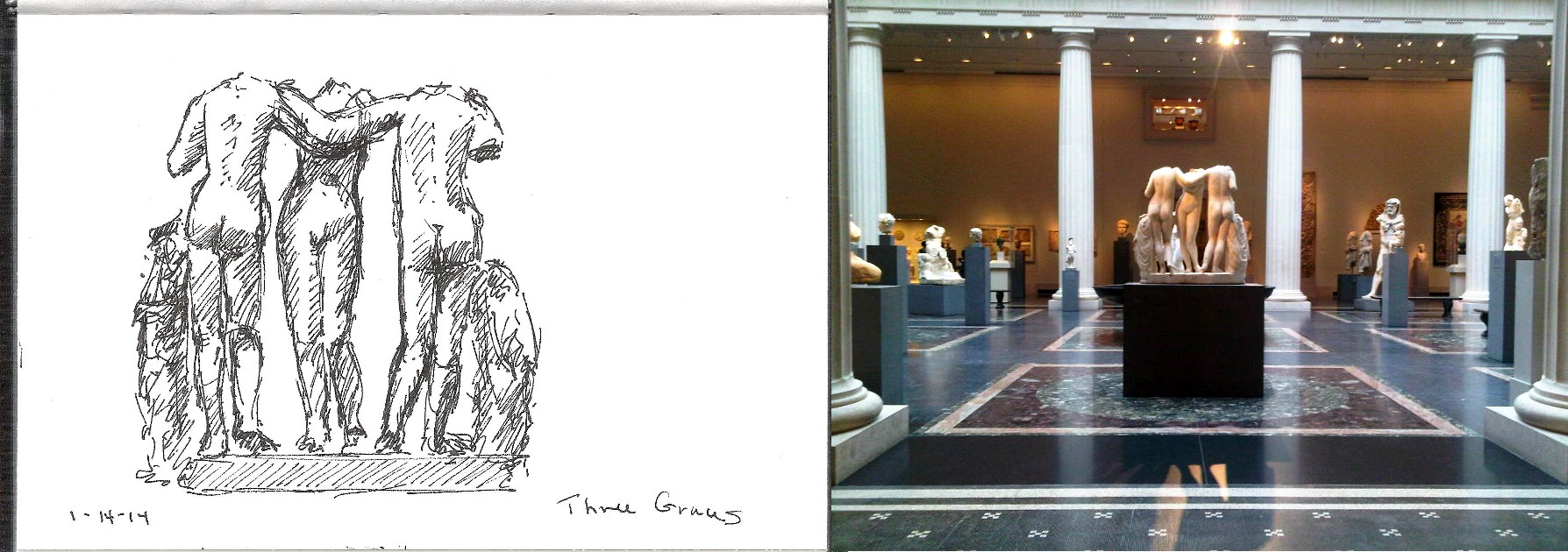
The Three Graces at the Met

The Three Graces at the Met

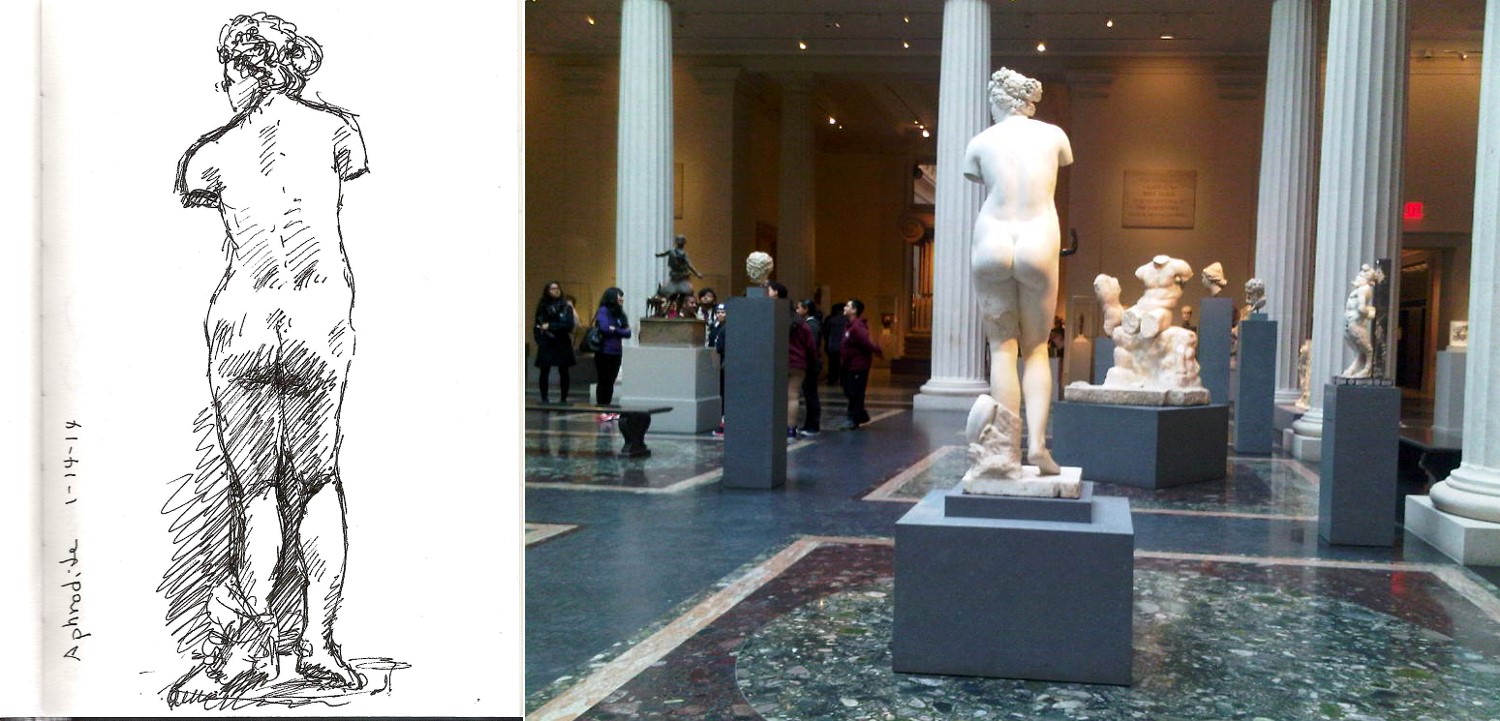
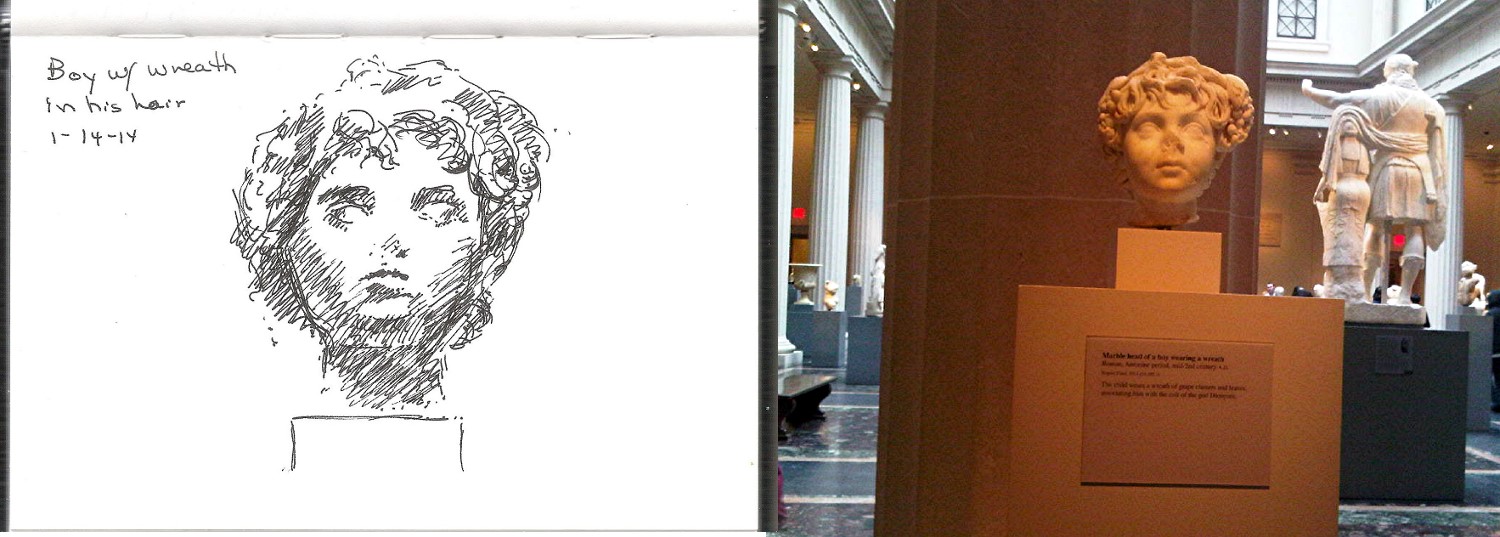
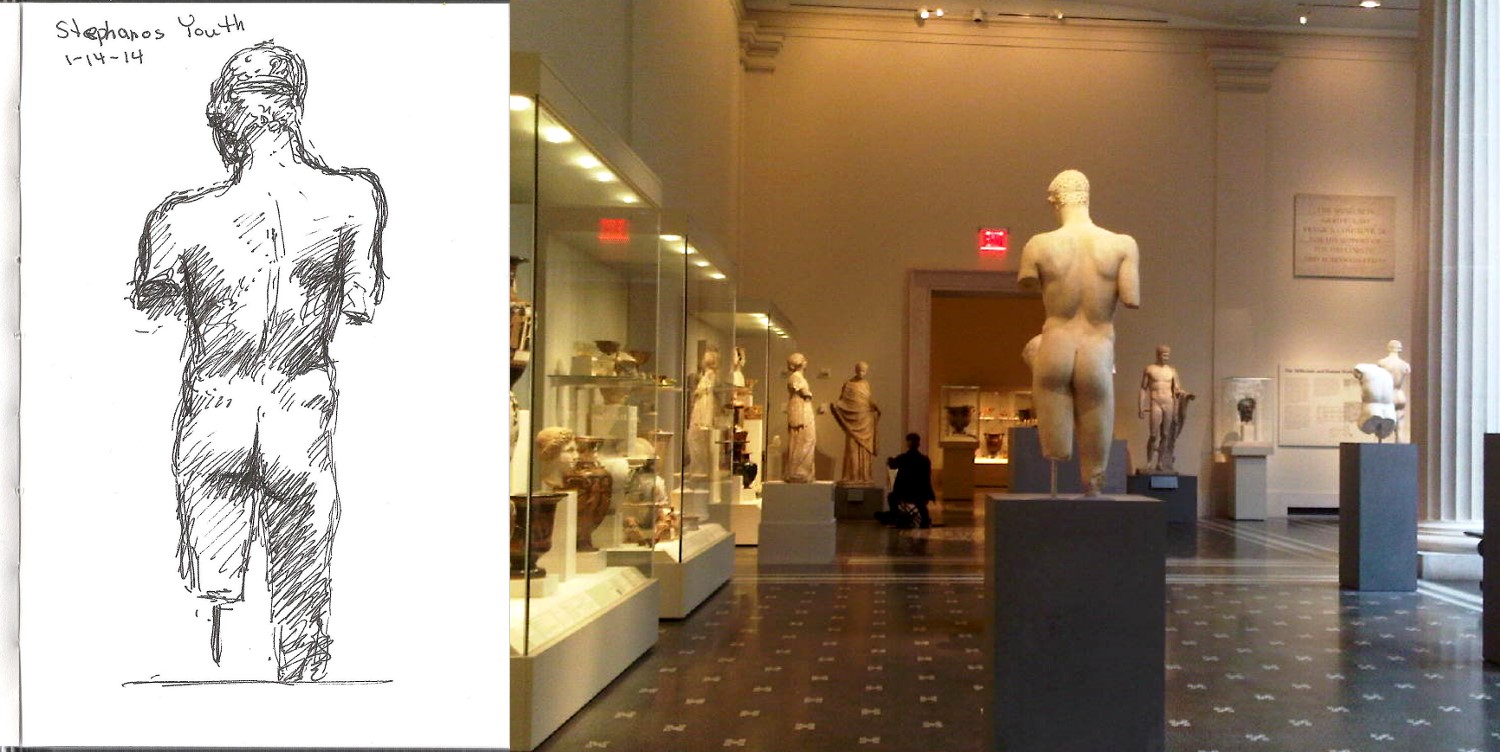
I was in New York last week.  At the end of my trip, I had a few hours before I had to catch my plane so I went up to the Metropolitan Museum of Art.  This is a favorite haunt of mine.  Big surprise.  This time, I decided to spend some time in some different areas.  First I went to the Greek and Roman sculpture area.  Very inspiring.  I whipped out my small sketchbook that I always keep with me and practiced on these beautiful statues.

I believe that every artist should practice sketching as much as possible, daily at least.  This is the artist’s equivalent to a musician practicing scales or an athlete throwing pitches.  You should do it enough that capturing what you see before you becomes second nature.

I usually travel with at least a small sketchbook, a commercial permanent ink pen, and maybe a set of colored brush pens.  I like Faber Castell shades of grey or their landscape package.

The subject doesn’t really matter although my sketches are usually just memory joggers.  My hotel room, at dinner or the theatre, in the museum, on the street.  Sometimes people will approach you to see what you are doing, however, most people won’t even notice.  I’ve leaned up against buildings at night and have drawn street vendors on Times Square, stretch limos, the night buildings in fog.  The drawing makes me “see.”  There are many better draftsmen than me…but it works for me.  Try it yourself.  Also, check out Urban Sketchers for some real inspiration.

Aphrodite at the Met

Aphrodite at the Met

Boy Wearing Wreath

Boy Wearing Wreath

Stephanos Youth

Stephanos Youth


To give or not to give – that is the question

All artists at some time are faced with the question of whether they should give their artwork to someone or not.  Yes, I know, the work just seems to accumulate, doesn’t it?  So we look around, oh, Aunt Sally would love that painting.  Maybe…maybe not.

I will admit to have given away many paintings over the years although not recently.  Currently I wait until someone has actually expressed an interest in my work.  And I don’t easily part with my show-stoppers as gifts unless they have been hanging around for a while.  Artwork is such a personal thing that I don’t want to burden my friends and relatives with some unwanted artwork, especially if I’m giving it to them in person.  Remember that too polite, “Oh, isn’t that…special.”  NOT!

So, if you are thinking about gifting someone with your personal creations this holiday season, I have the following recommendations.

  • Make sure that that they really have expressed interest.
  • Look around their homes to see that what you plan to give them actually fits in with their style.
  • Ask yourself if you’re just being cheap or if you believe they would really welcome a piece of artwork from you.
  • Is it a quality product?  Would you be proud to display it in your own home?
  • Perhaps you could exchange some work with a friend whose work might be better appreciated by the recipient?  How about a painting for a piece of pottery or some sculpture?  Or your realistic work for something more modern or abstract?

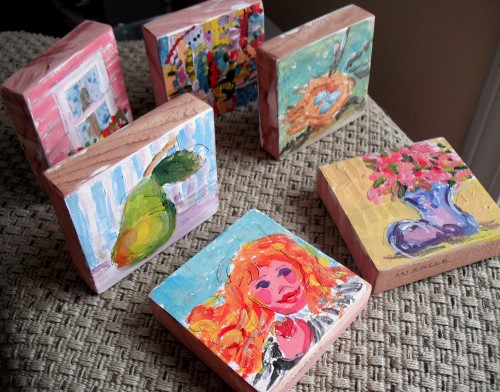
These are just a few suggestions.  I am not gifting anyone my artwork this year except these stocking stuffers.  I call them “portable art”, which are really mini paintings on cedar.  A realistic painting on one side and an abstract on the other.  Since they’re cedar, they can be tossed in a sweater drawer if the recipient really doesn’t care for them.

Portable artwork - mini-paintings on cedar blocks

Portable artwork – mini-paintings on cedar blocks

What is your painting style?

At some point in your painting career, you’ll wonder if you’ve got a painting style.  Would someone be able to point to one your paintings and say, “Oh, that’s a John Smith!”  It’s always nice to be known for a certain style but many of us find it difficult to recognize our own.  The following are some of my thoughts and observations about this.

  • Your style is like your signature, a certain way of handling your materials, your brush strokes, maybe your palette, or your subject matter.
  • It may take years to develop a recognizable style.  In the meanwhile, most artists experiment with many types of painting, often copying our favorite painters.  This is a great way to see what excites you and to test the waters.  How did Monet capture that light?  How did Picasso make the most of his materials?  Eventually you’ll find a style that suits you.
  • Your style may…and probably will…evolve over time.  It’s pretty unusual for an artist to find one particular way of painting and to never change again.
  • While your work may change over time and while you are having fun learning how other painters create, at some point it’s a good idea to focus on one style for a while.  When an artist shows me a portfolio with a mishmash of subject matter, techniques, and mediums, and who exclaims, “I can paint anything!” the first thought I have is “amateur.”
  • You need to focus.  What are you passionate about?  What is your emotional connection?  What reaches into your chest and grabs your heart?  That is what you need to paint.  At least for a while.
  • Build up a body of work.  Do maybe twenty paintings that are similar in technique, subject matter, medium, etc.  Some people say to create as many as 100, which seems a little excessive to me but, well, whatever works for you.  You just need to prove that you have the tenacity to focus to create a body of work.
  • Stand your paintings around the room and ask a trusted friend, preferably a knowledgeable artist or teacher to give you their honest opinion.  How would they describe your work?  What are its strengths, weaknesses?  Close relatives are usually not good at this because they love everything you do.  And beware of someone who may have an ax to grind.  You definitely do not need their opinions to undermine your self-confidence.
  • Listen to what they say.  If someone says, “That’s an awful lot of yellow in your work,” maybe you need to reevaluate.  Or if you’re aiming for super realism, and your friend says, maybe the shape on that bottle could be worked on, that means you need to work on your drawing skills some more.
  • And finally, as I have said before, be kind to yourself.  Your work is continually evolving and that’s OK.  You may still be sailing for the horizon which continually moves beyond you.  Sometimes you need to stop and take a reckoning of how far you’ve come already.

There is a lot of other advice about how to identify or create your style, but these tips will provide you with the basics.  Please let me know if this posting is helpful to you or if you have any other questions.

How to find time to paint

“I’m so busy.  I don’t have time to paint.”

I hear this excuse more than any other when people are telling me why they aren’t creating.  Really?  Although I don’t chastise anyone when I hear this excuse, I often wonder how much time they’re spending on other less productive activities.   I work full time in a demanding job with irregular hours, have a large garden and often have a grandchild here.  I usually paint a couple of hours every evening and maybe ten hours on a weekend.  This is the equivalent of a part-time job!  I have a friend who gets up a couple of hours early every day to do her painting.  She’s working on her MFA and also has a full-time job. If you want it badly enough, you’ll find the time.   So I thought I’d compile a list of my top five suggestions for finding time to paint.

1.  Find a place to be able to keep your materials at the ready. If you have to unpack and repack your painting gear every time you want to use it, you’ll probably not do it as often. I am fortunate that I have a studio which is detached from the house but there are many other ways to carve out a bit of space.  Do you have a spare room, corner of the basement or attic, or even a closet which can be converted to a studio?  Even a corner of a room with a screen to hide your “mess” will make it more convenient for you to work.

2.  What can you give up?  For me, it’s TV.  I honestly watch very little TV every week.  Maybe the news and Antiques Roadshow, maybe a movie once in a while.  But I couldn’t tell you who is on Dancing with the Stars or what the new sitcom is.  And this is in a house with satellite TV and a kazillion channels!  But…do you have too many hobbies?  Maybe you will have to cut back somewhere else to concentrate on your most important creative work.  Do you stop at the local tavern after work every day to unwind?  How much time does that waste?  No one expects you to become a hermit but you have to set some priorities somewhere.  You have to make choices.

3.  Look for small nuggets of time which you can use fruitfully.  Can you head to the park on your lunch hour?  How about pulling out your sketchbook on the way home if you are a train commuter?  (I have an hour drive every day so I listen to books on tape.)  Waiting in line, at the theatre, or in a restaurant are other places you can do a few quick sketches.  Check out Urban Sketchers for some great ideas.

4.  Do a little bit of art every day.  This will keep your juices flowing and keep you in the creative mindset.  Keep a small sketchbook in your pocket or purse.  Add a few colored markers or a mini watercolor set and you’re good to go.  These are often inspiration for larger pieces later.

5.  Ask for some help.  If you have small children, hire a babysitter or enlist the help of a significant other, friend, spouse.  Maybe even trade time with another creative person who is looking for some alone time.

6.  Be easy on yourself.  Even if you can’t stick to a perfect schedule, as long as you’re moving in a positive direction, you’re making progress.
Pecos River Valley, Step-by-Step

Pecos River Valley, final, oil on canvas,  18 x 24,  Kit Miracle

Pecos River Valley, final, oil on canvas, 18 x 24, Kit Miracle

As much as I loved Arizona, I was also enamored with New Mexico and the Pecos River Valley.  I spent one day at the ruins of the Pecos Indians which are preserved as a national park now.  From the top of the area, I could see for miles.  This is one view of the Pecos River Valley. https://my90acres.com/artwork/pecos-river-valley-step-by-step/


Sedona Hills at Sunset

Sedona, final, oil on canvas, 15 x 27, Kit Miracle

Sedona, final, oil on canvas, 15 x 27, Kit Miracle

I fell in love with the red hills in Sedona, Arizona on my recent visit there.  This is a long painting, 15 x 27, which represents the landscape at sunset.  Just north of Bell Rock at sunset.  Check out the link for a step-by-step. https://my90acres.com/artwork/sedona-hills-at-sunset-step-by-step/

Junipers at Grand Canyon – Demonstration

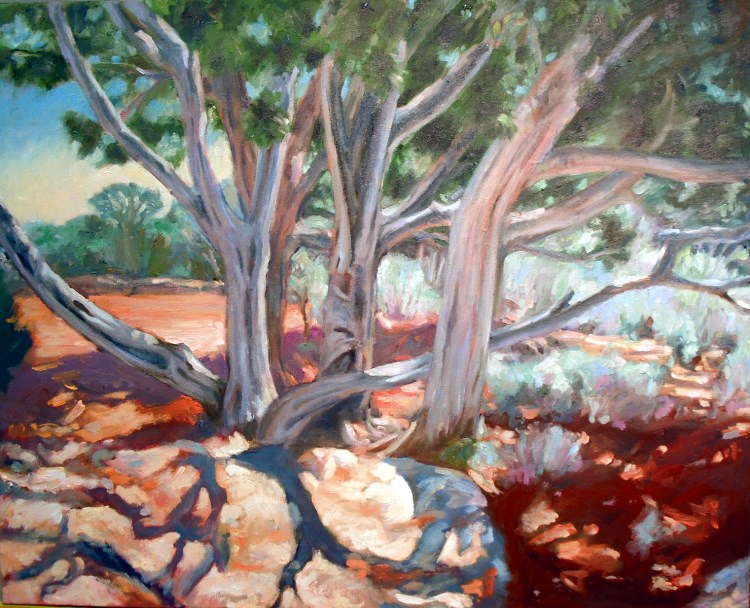
Junipers at Grand Canyon, final, oil on canvas, 24 x 30

Junipers at Grand Canyon, final, oil on canvas, 24 x 30

I just completed this 24 x 30 oil painting of Junipers at the Grand Canyon.  I love their gnarly trunks and timeless quality.  Check out my demonstration at https://my90acres.com/artwork/junipers-at-grand-canyon-demonstration/


new eyes

Sometimes it takes a little nudge to get us out of our ruts. I’m currently traveling in the southwest with a bunch of canvases and paints. They say that travel is good for the soul. All I can add is that it makes me see the world with new eyes.  I love the colors, the vistas, the entire flavor of this part of the world.  This is a photo taken as I was perched on the edge of the Grand Canyon. I also spent several days painting the red rocks of Sedona.  Now I’m in Santa Fe. I’ve discovered that it’s best not to look at the work of too many other artists as I lose focus on my own vision. I brought 19 canvases and intend to return with 19 paintings.  Of more or less achievement. Stay tuned.Image

Improving a Painting

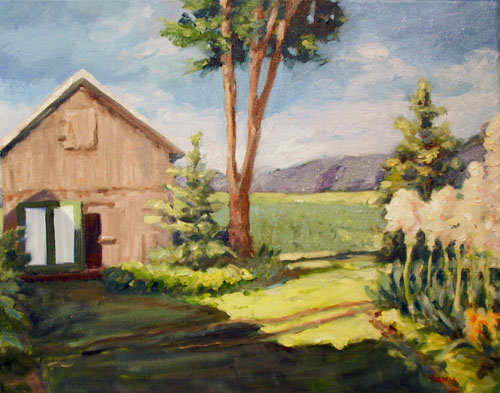
Blessinger Farm revised.  Oil on canvas, 16x20

Blessinger Farm revised. Oil on canvas, 16×20

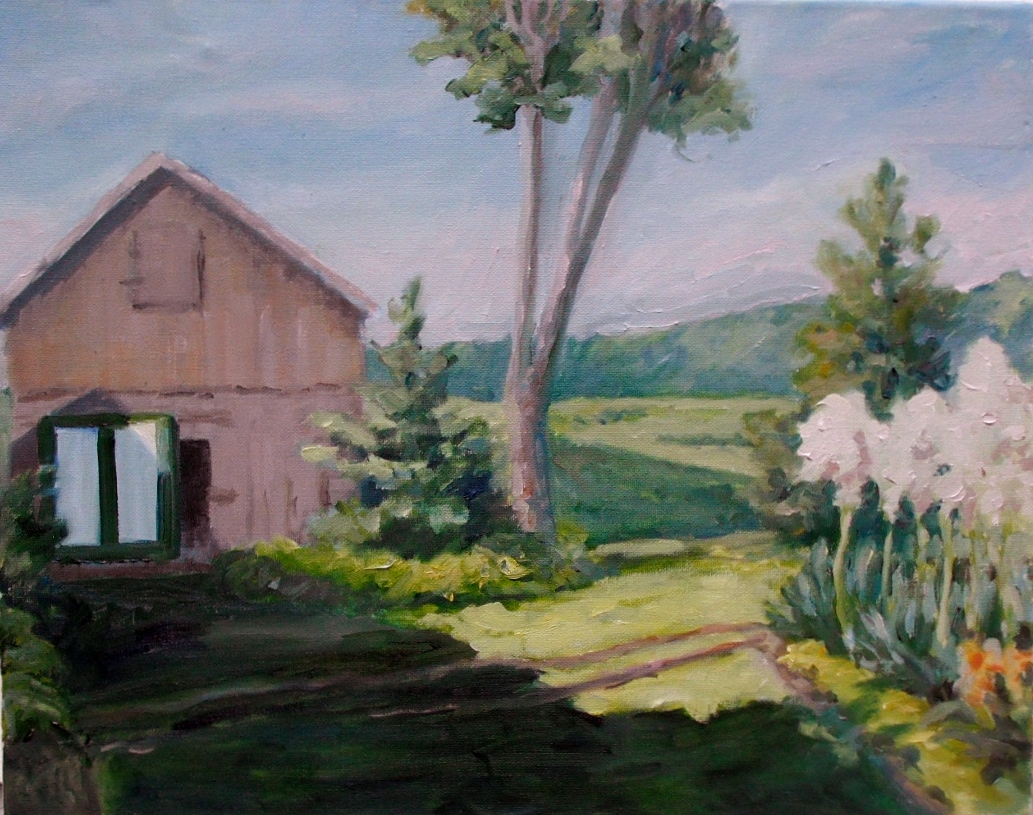
The first pass at the Blessinger farm painting.

The first pass at the Blessinger farm painting.

Sometimes when I finish a painting it seems OK, but….something is not quite right. That’s when I let it sit on the easel for a while. Such is the case with the one that I posted here a few weeks ago, Blessinger’s Farm. After examining it for several days, I realized that several improvements could be made.

First of all, the tree was right in the middle of the painting. This is very poor composition as it divides the canvas in half. It was also a weird looking tree but that may have more to do with the fact that a tornado blew through the farm a few years ago wiping out 80 year old maples. Nevertheless, I decided to move it closer to the barn (easy to do in paint, right?) and to juice up the colors. I also decided to push the background way back. Too much green. And to clarify some of the focal points. What do you think?