
Happy Valentine’s Day, 2018, watercolor, pen and ink, Kit Miracle
Best wishes and hugs to all my friends. May you enjoy some time with your sweetie this day.
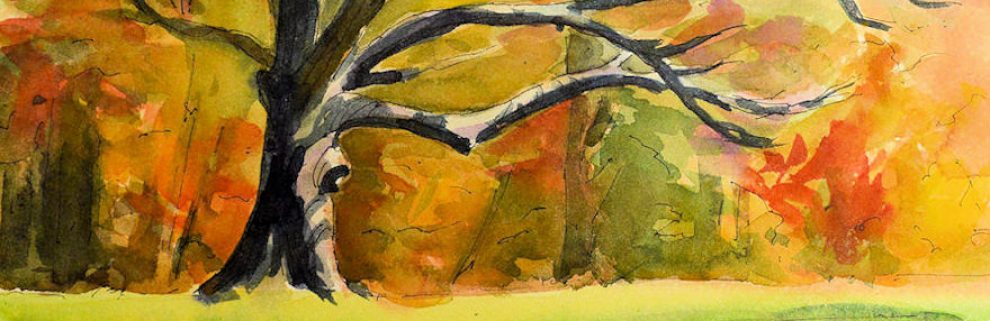
Happy Valentine’s Day, 2018, watercolor, pen and ink, Kit Miracle
Best wishes and hugs to all my friends. May you enjoy some time with your sweetie this day.
Comments Off on Happy Valentine’s Day!
Posted in holiday, pen and ink, watercolor
Tagged art, kit miracle, love, mouse, mouse painting, pen and ink, valentine, watercolor
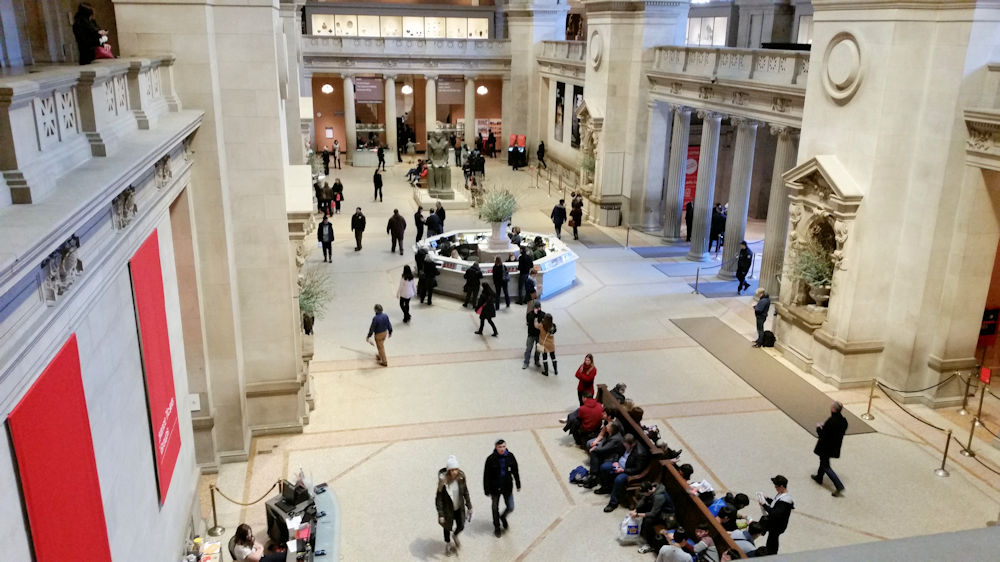
The Metropolitan Museum of Art main lobby
One of my favorite places to visit in the world in the Metropolitan Museum of Art in New York. I always manage to squeeze in a visit every time I’m in the city. I’ve been there so often that I know the best/least crowded entrance. And I always go straight to visit my favorite paintings and sculptures.
Generally after visiting the European galleries on the second floor to say hello to the Van Goghs and Monets, I make my way over to the American wing to visit the Sargents, Cassatts and other American painters.
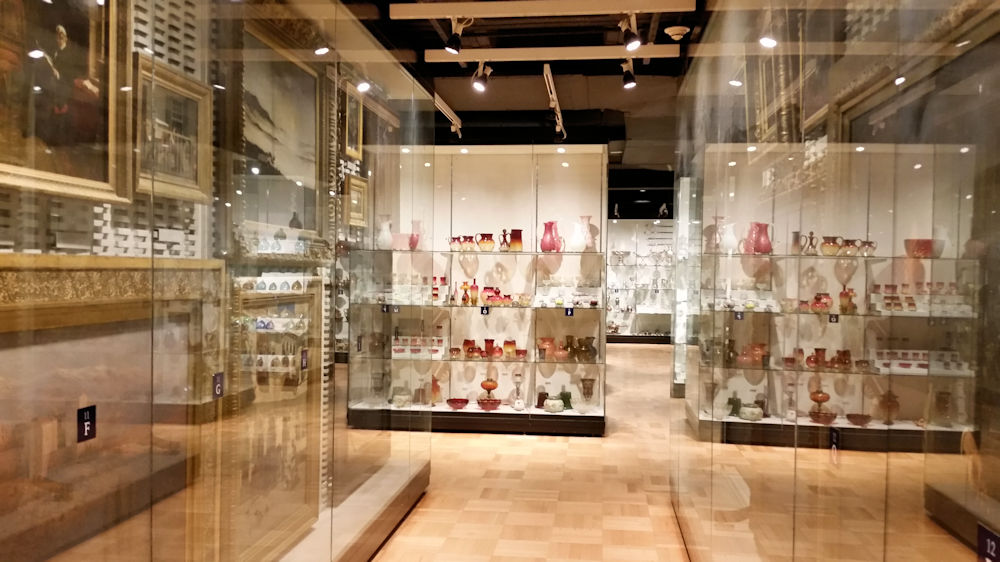
The Henry R. Luce Center for the Study of American Art in the lower level of the Metropolitan Museum of Art
However, several years ago, I discovered a “secret” basement area where many treasures are stored which are not on display. Officially called The Henry R. Luce Center for the Study of American Art, there are cases filled with costumes and glassware, china and silver, and a whole lot of furniture. And, to my surprise, I discovered cases filled with some extremely famous paintings by some of my favorite painters. It’s a marvel to think that this museum has so much artwork that they can’t even display it all! But I guess that many pieces are circulated to international exhibits so they always have some replacements available.
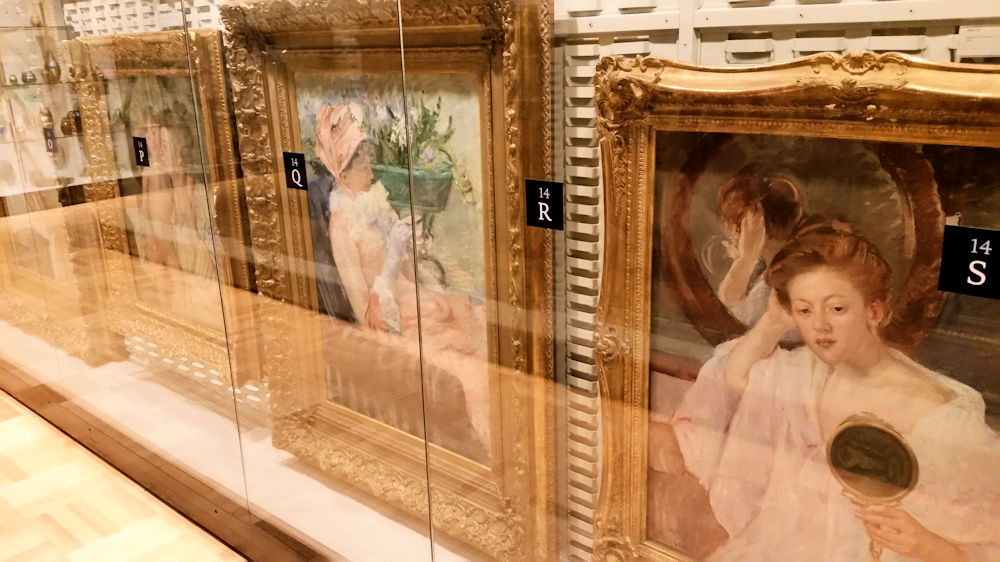
Cassatt paintings “in the basement” at the Met.
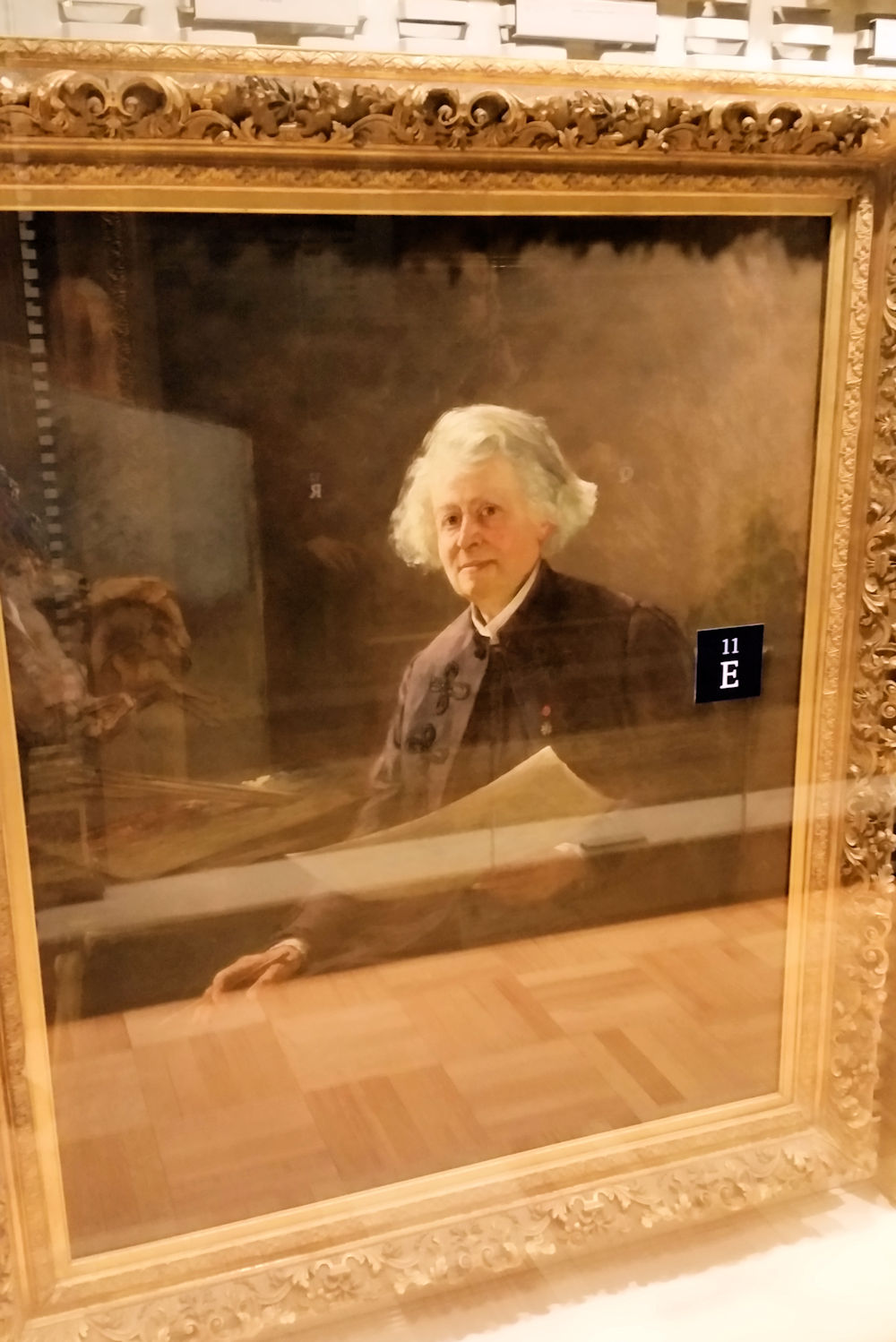
Portrait of Rosa Bonheur (The Horse Fair) by Anna Klumpke
Last year I discovered many of Mary Cassatt’s most famous pieces, a portrait of the painter Rosa Bonheur (The Horse Fair), and a large painting by Edward W. Redfield of the American Impressionist group. This doesn’t begin to cover the paintings crammed into this area.
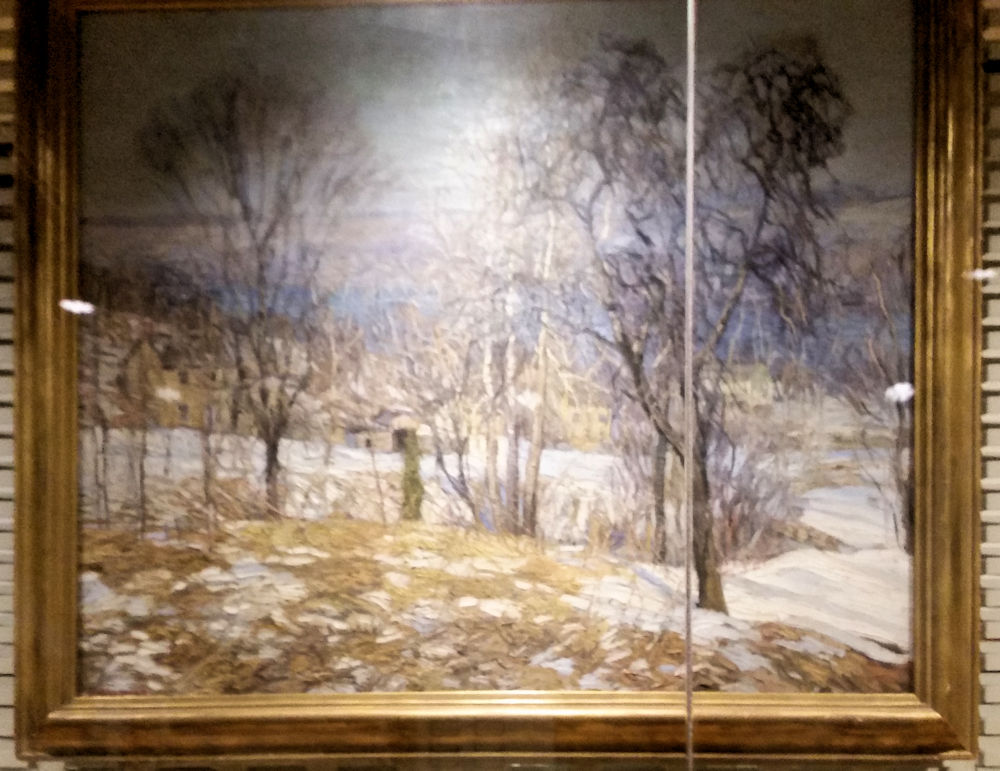
Edward W. Redfield painting on display in the Luce Center at the Met
So, next time you’re visiting the Met, make sure to try to find this subterranean treasure trove. If you get close to the American Wing, you may have to ask for directions on how to get there. I usually enter from the North side of the café court.
Posted in Uncategorized
Tagged art, cassatt, Henry R Luce, hidden treasures, kit miracle, metropolitan museum of art, museum visit, redfield

50 Cents, farmers market still life with contre jour lighting (back lighting). Acrylic on canvas board, 20 x 16, Kit Miracle
My studio is an old summer kitchen about 30 feet from the back door. It was built to keep heat out of the house, therefore it is not insulated. In the winter I often work with a hat, two pairs of socks and multiple layers of clothes. Despite the old leaky building, I worry about breathing paint fumes from the oil paints. Even though odorless turpentine is supposed to be, well, odorless, it isn’t. And even if it were, I would still be exposed to the fumes. Not good.
So when a friend recently gave me several canvas panels, I decided it was time to try something new. These panels are all 16 x 20. I don’t usually use canvas panels this large but why not?
I decided to work on my acrylic painting skills and toned several of the panels in red. (See the links at the end of this post for other pages about using toned canvasses.) I like using red as little bits peek out, adding a lot more life.
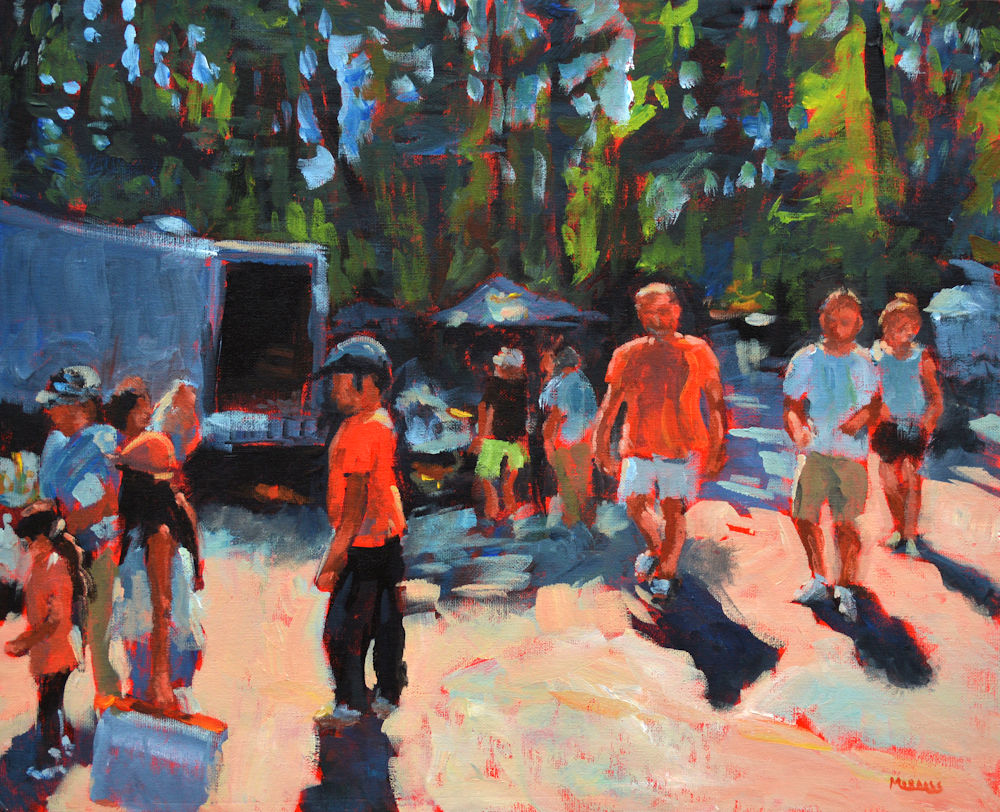
At the Flea Market, acrylic on canvas board, 16 x 20, Grafton, MA Kit Miracle
Acrylic paint has some of the best and worst properties of watercolor and oil paint. It is water-based and dries quickly. It is also has the opacity of oil paint along with texture. But it requires a lot of planning and forethought before you can even begin the painting process.
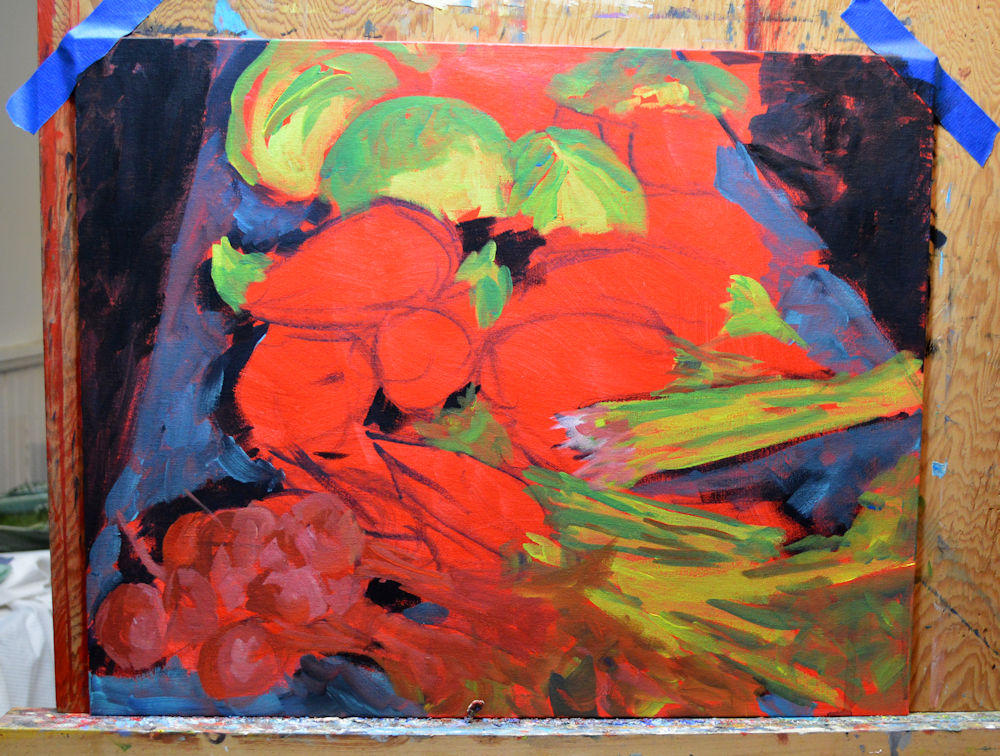
Farmers’ Market Bounty – in process. Notice the loosely drawn vegetables. The actual painting is much more vibrant than the photo shows.
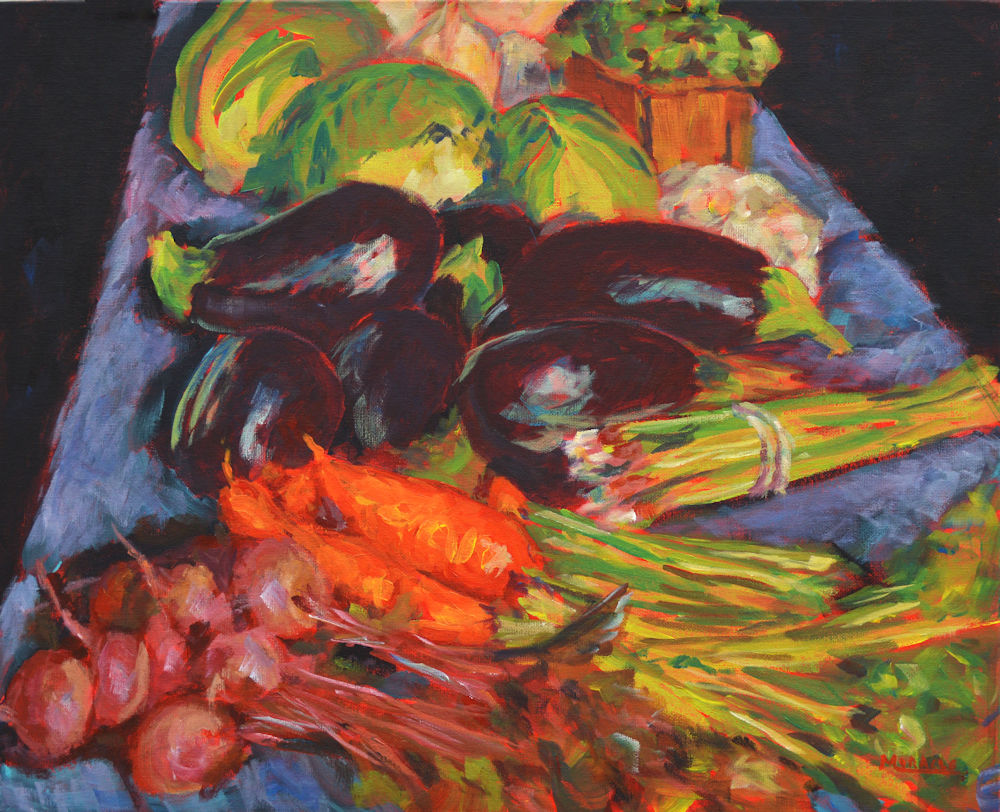
Farmers Market Bounty, acrylic on canvas board, 16 x 20, Kit Miracle
These four paintings were created relatively quickly. I deliberately used larger brushes and aimed for the feel of the subjects rather than fussing over too many details. The subjects were from photos that I took at some farmer’s markets and flea markets last year. I also thought it would be interesting to paint some crowd scenes. Anyway, I’m pretty pleased with the results.
Check them out below. Check out my Etsy site for more details photos. Yes, they are for sale.
I always welcome feedback.
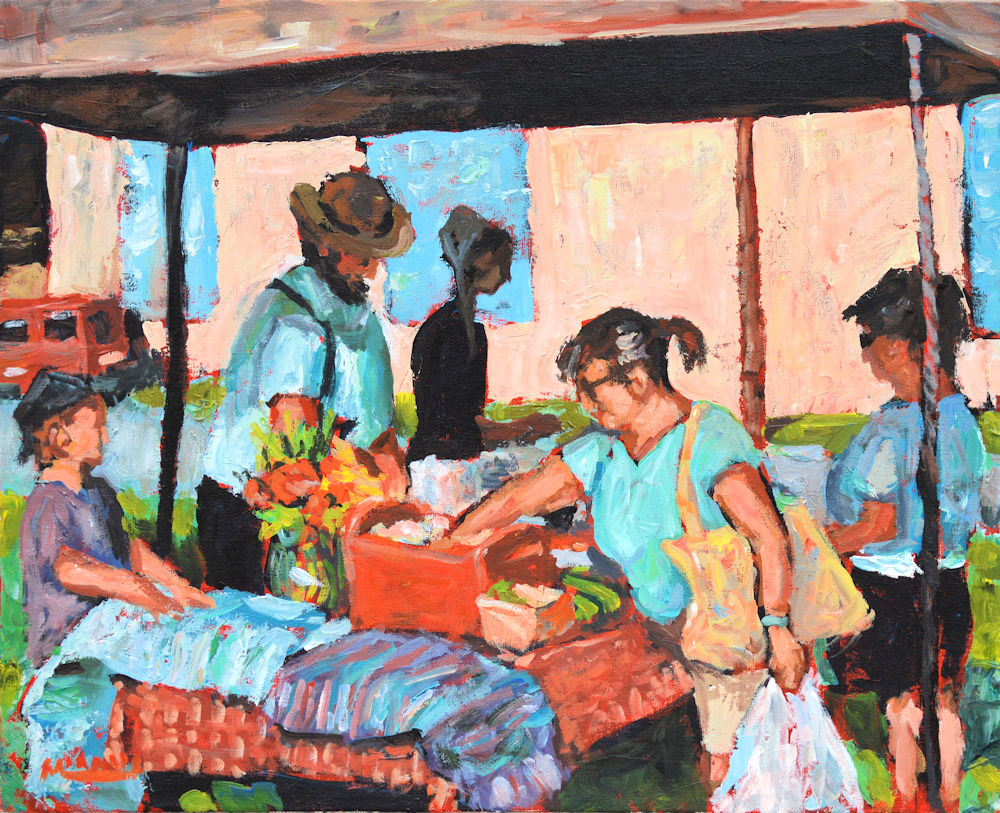
Saturday Morning at the Farmers Market, acrylic, 16 x 20, Kit Miracle
Other links. Painting on a Toned Canvas – Step-by-step.
Also, search for toned canvas for several other posts about the subject.
Comments Off on Painting on a toned surface
Posted in painting instruction
Tagged acrylic, art, farmers market, flea market, kit miracle, painting instruction, toned canvas
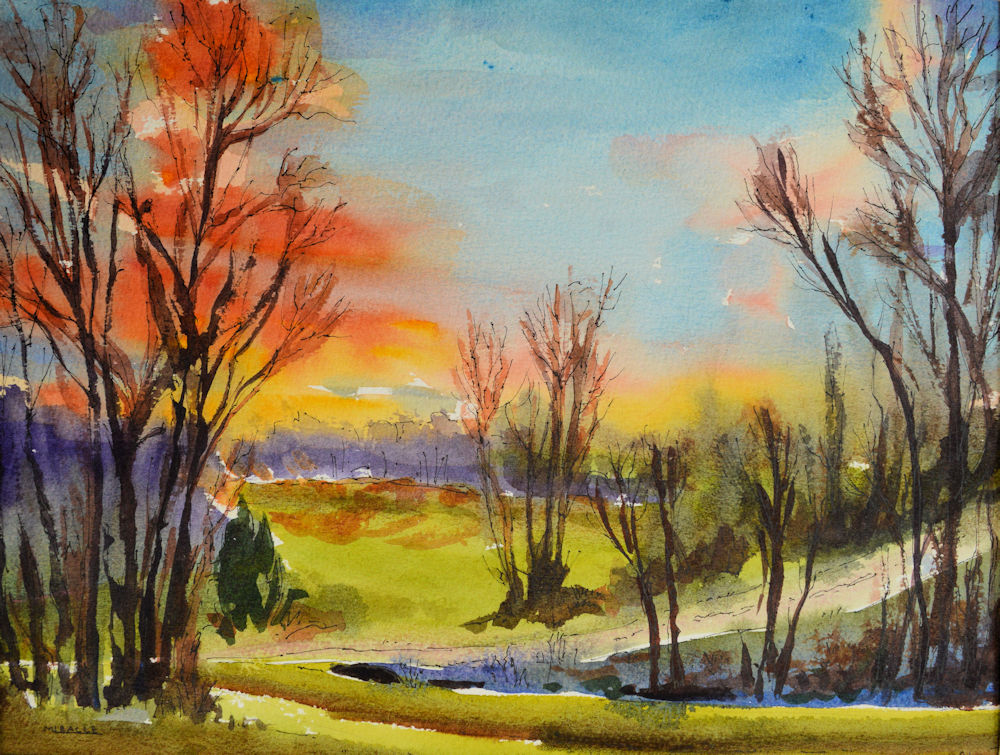
Sunset in watercolor with pen and ink. This is a quarter sheet of Arches 140 pound cold press paper, I juiced up the colors a bit. Click on the painting to see more detail.
Last week I discussed some of the intricacies of creating paintings with watercolor and pen and ink. This week I will go into more detail.
Support
I always use top quality watercolor paper. This is at least 140 pound pure rag paper. I like Cold Press which has a little tooth. Some people like the Hot Press which is very smooth. Rough has a very rough texture and is a little difficult to draw on with a pen. Of course, heavier paper is fine. Lighter weight paper tends to buckle and is not so good for water media.
The paper is usually divided into quarter sheets (a full sheet is 20 x 30 inches) and is taped to a board. You can use a drawing board, heavy plywood, or some other heavy support. If I use a full sheet of paper, I “stretch” the paper and staple it to the board. It actually bends the ½ inch finish grade plywood that I use!
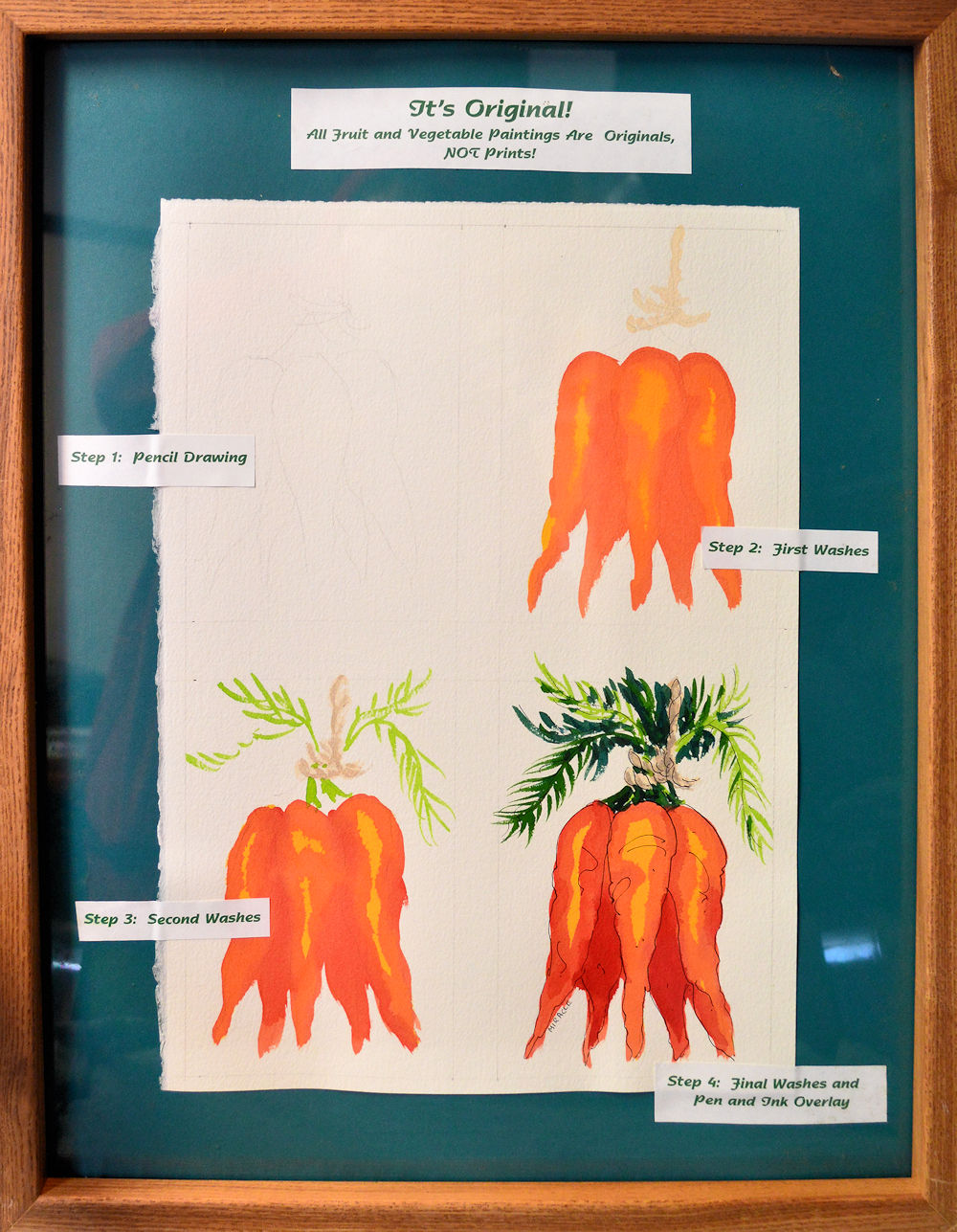
This is a demonstration of the steps I take for creating a small watercolor with pen and ink. I use this method for most of the fruits and vegetables which appear on my Etsy shop, my90acres. I divide this quarter sheet of watercolor paper into four rectangles of a little more than 4 x 6 inches with some space left between the squares.
Drawing
I start out with a rough pencil sketch done with a #2 pencil. In the case of architectural elements, you may wish to add more detail but generally keep the sketch loose. You don’t want to get to the point of coloring in the sketch. Also, beware of erasing too much or of bruising your paper. This will mark you paper so that when you apply the watercolor, it will soak into the paper, leaving dark marks.

This is the painting of the Falls in plain watercolor before the pen and ink is applied. As you can see, it is a very nice painting and stands on its own merits. Reminds me somewhat of Winslow Homer.

Painting of the falls at Bald Mountain Tennessee. This watercolor has had the pen and ink applied to it. Check out the detail to see how loosely the ink part is done.
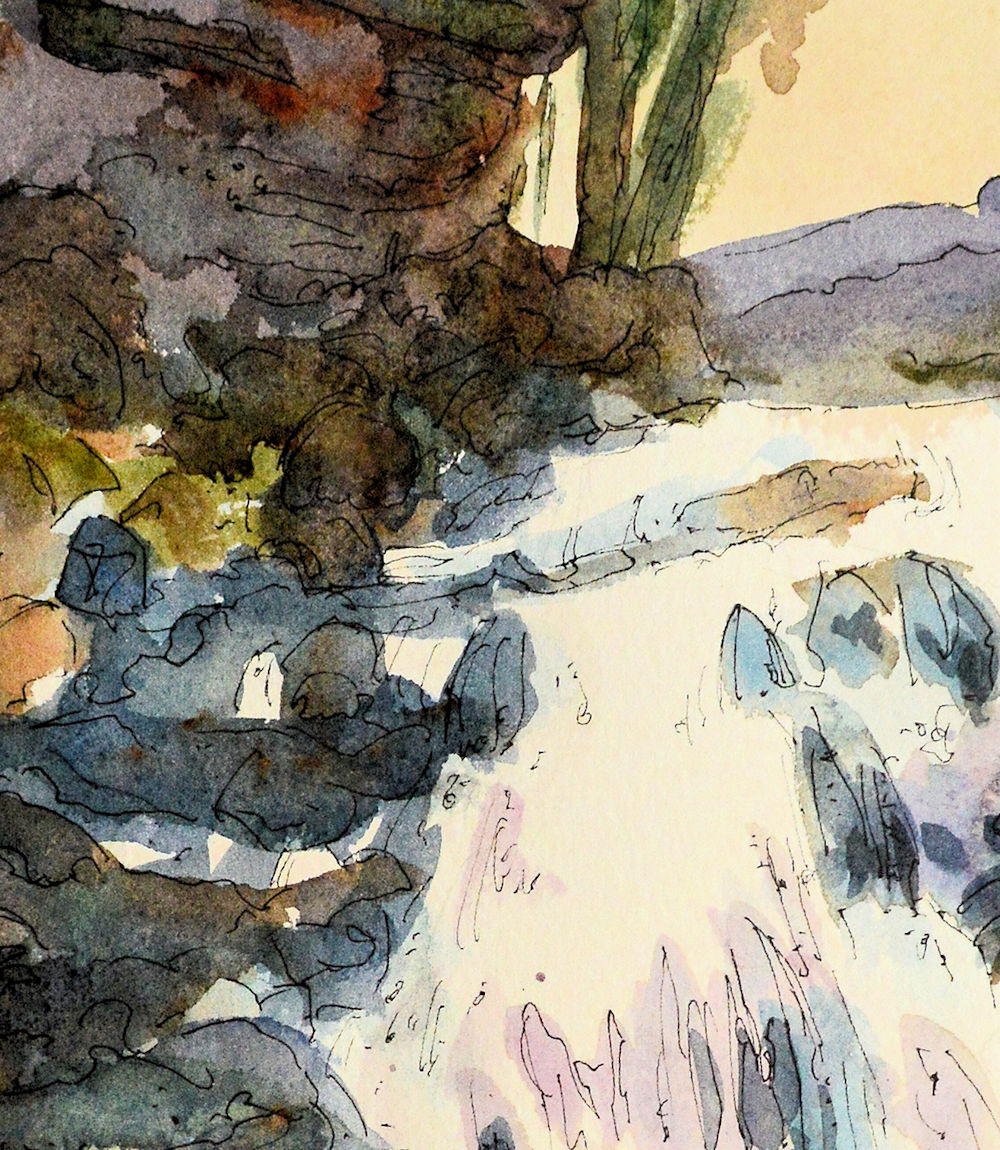
Close up view of the painting Falls at Bald Mountain. See how loosely the ink lines are drawn.
Painting
I always use Winsor Newton artist grade watercolors. I apply the paint starting from light to dark, making sure to keep the white areas free. I do not use any masking fluids. Try to paint in bigger strokes and not get too fussy. You may need to let the paint dry between layers.
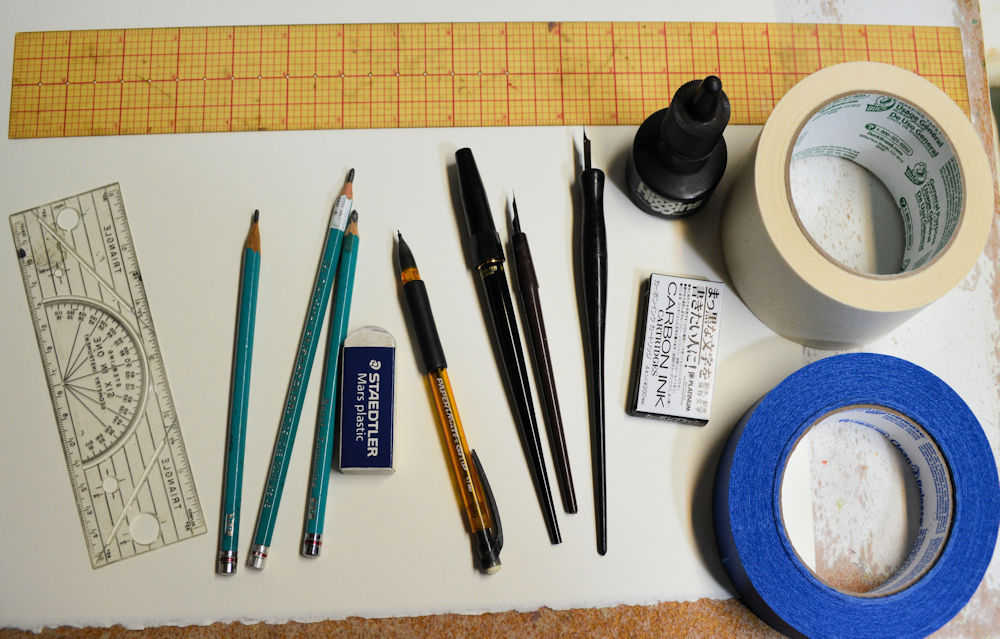
These are the general tools that I use for my watercolor and pen and ink paintings. The large ruler (actually a quilting ruler) is what I use to lay out the painting squares. The small ruler is sometimes used where I need a straight line. Pencils and a plastic eraser, the platinum pen and two dip pens, India ink, carbon ink cartridges for the platinum pen, tape, either regular masking tape or painter’s tape.
Sketching with ink
At this point, you may decide not to apply any pen and ink. See the samples of the waterfall.
If I decide to apply some details with pen and ink, I do so very loosely. Do not try to add every detail. Let the viewer’s eye add the details.
For many years I used a dip quill pen #3 and plain old India ink. I like the bounce and variance of the lines. I would also buy the nibs in bulk because I like a sharp point.
Then I moved to some commercial pens. I like the Lamy Safari.
My current favorite is the Platinum Carbon Ink pen. It has great flow and the carbon ink is light-fast. It is also permanent and doesn’t seem to smear if you have to apply some more water media on top.
The real key is to draw with your whole arm, not just your fingers. Keep it very loose.
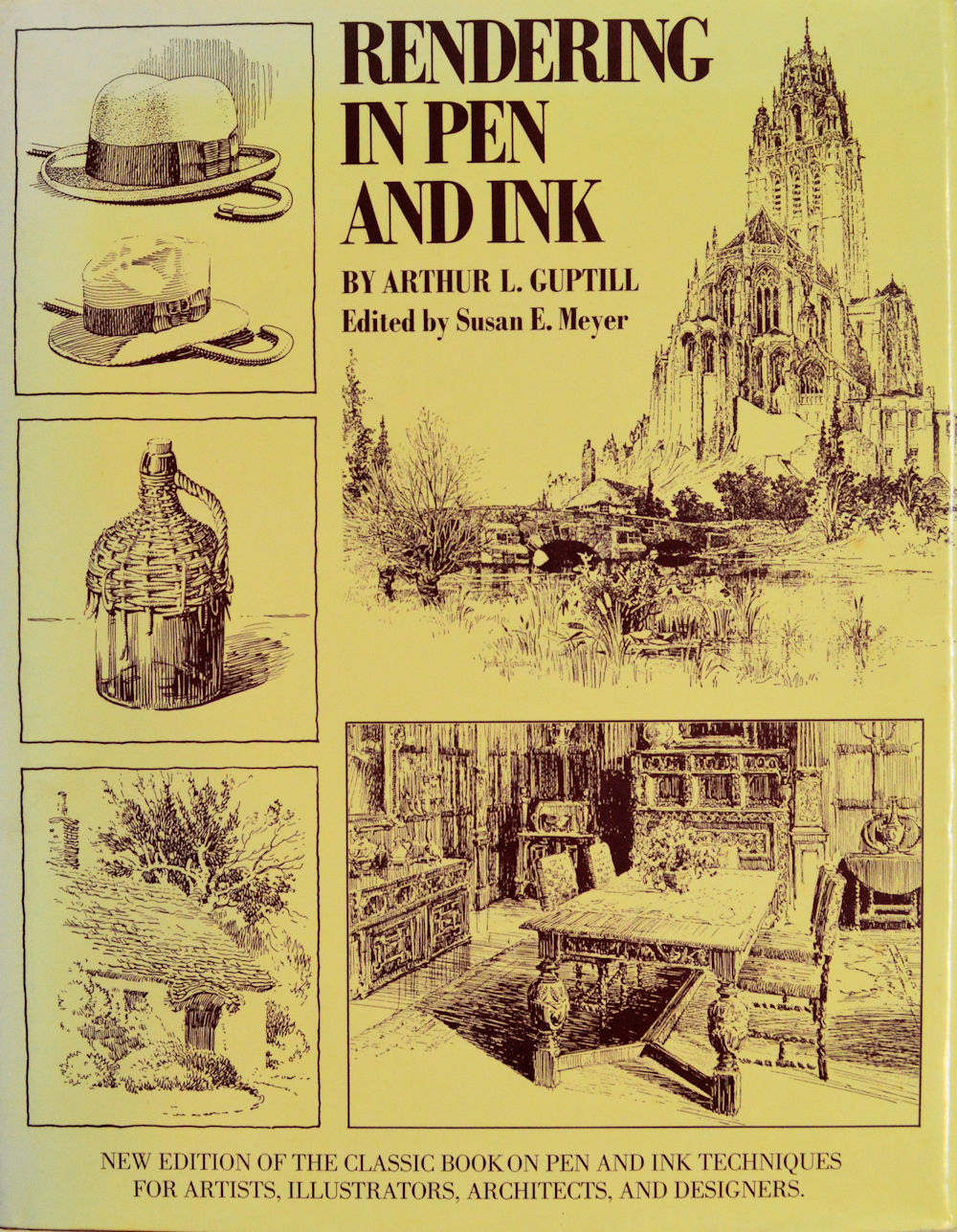
Arthur L. Guptill’s book Rendering in Pen and Ink. This is an old book but probably has the most extensive demonstrations for pen and ink.
One of the most beneficial books about Pen and Ink instruction is Arthur Guptill’s Rendering in Pen and Ink. Although a little dated, the information is very useful for technique.
So, this is my method of using watercolor with pen and ink. Please feel free to contact me if you have any questions or need more clarifications.
Also, check out some of my previous postings on this subject. Links listed below. Also, search for pen and ink for more demonstrations.
Comments Off on Watercolor with Pen and Ink – Part 2
Posted in art, painting instruction, pen and ink, watercolor
Tagged art, kit miracle, painting instruction, pen and ink, watercolor

Rockport, MA. Watercolor, pen and ink, 10.5 x 14, Kit Miracle
There are many styles of watercolor with pen and ink overlay. Some artists do the pen and ink drawing first and then add the watercolor washes on top. If you use this method, you must be sure that the ink is totally waterproof and won’t smear once the watercolor hits it.
In my case, I draw a pencil sketch first before adding the watercolor washes. After it is totally dry, I then go back and add the pen and ink details. I have used this method for twenty-five years but I suggest that you experiment with several methods to find what works best for you.
All of the small paintings shown on my Etsy shop My90Acres are created this way. I like the looseness that this method allows me. If I were to draw the object first in pen, I would have a tendency to get too bogged down in the details. Then adding the the watercolor would feel more as if I were “coloring in” the painting. This seems to make the painting more static without much life, good for medical illustration but not the look I’m after.
I always begin a new wc/pi painting by marking off the outside edge of the painting (adding an extra ¼ to ½ inch) and then taping it down to a drawing board. I use at least 140 pound watercolor paper. Sometimes I’ll use painter’s tape but actually, regular old masking tape will work just fine if you’re not going to keep it on the board for months. A few weeks will be fine but you’ll probably be done with the painting before then. Taping the painting to the board will help reduce any buckling when the watercolor is applied.
The next step I take is to make a loose sketch on the paper. Be sure not to press too hard with your pencil or to do too many erasures as it will bruise the paper. Bruised paper will create dark splotches when the watercolor hits it; not an attractive sight unless that is the look you’re going for.
After the sketch, I apply layers of watercolor, usually working from light to dark. A hairdryer will speed up drying time between layers of paint. After the paint is totally dry, then I begin to add the ink drawing. I always start with the more complex parts of the painting, such as, the buildings. I might even carefully use a ruler for the straight lines, but the painting will look fresher if you just freehand it. The ink is just used to loosely add details; you don’t need to put in every brick and board, every blade of grass or leaf. Simplify the shapes and let the viewer’s eye fill in the rest.
Finally, after your painting and the ink is totally dry, you can use a plastic eraser to remove some of your pencil lines if they are still showing. Really! I don’t know how this works, but it does.
Take a look at these three paintings of Rockport, Massachusettes. Click on the paintings to examine some of the details.
Part 2 of this post will explore some of the materials and other techniques.
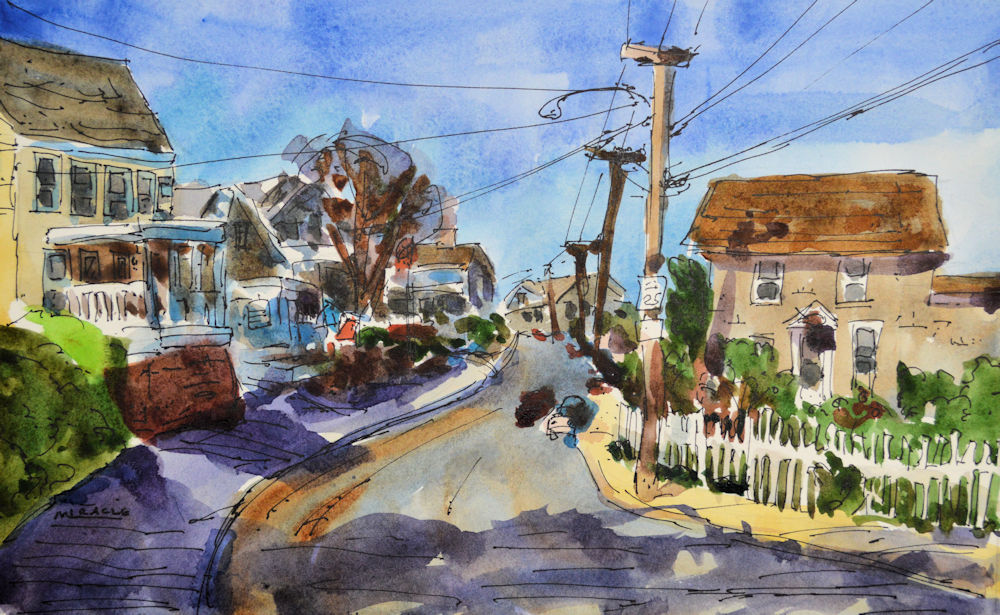
Main Street, Rockport,Massachusetts. Watercolor with pen and ink. 6.5 x 9.5 Kit Miracle

Beach at Rockport. 6.5 x 9.5 Watercolor, pen and ink. Kit Miracle
Posted in art, painting instruction, pen and ink, watercolor
Tagged art, kit miracle, painting instruction, pen and ink, travel, watercolor
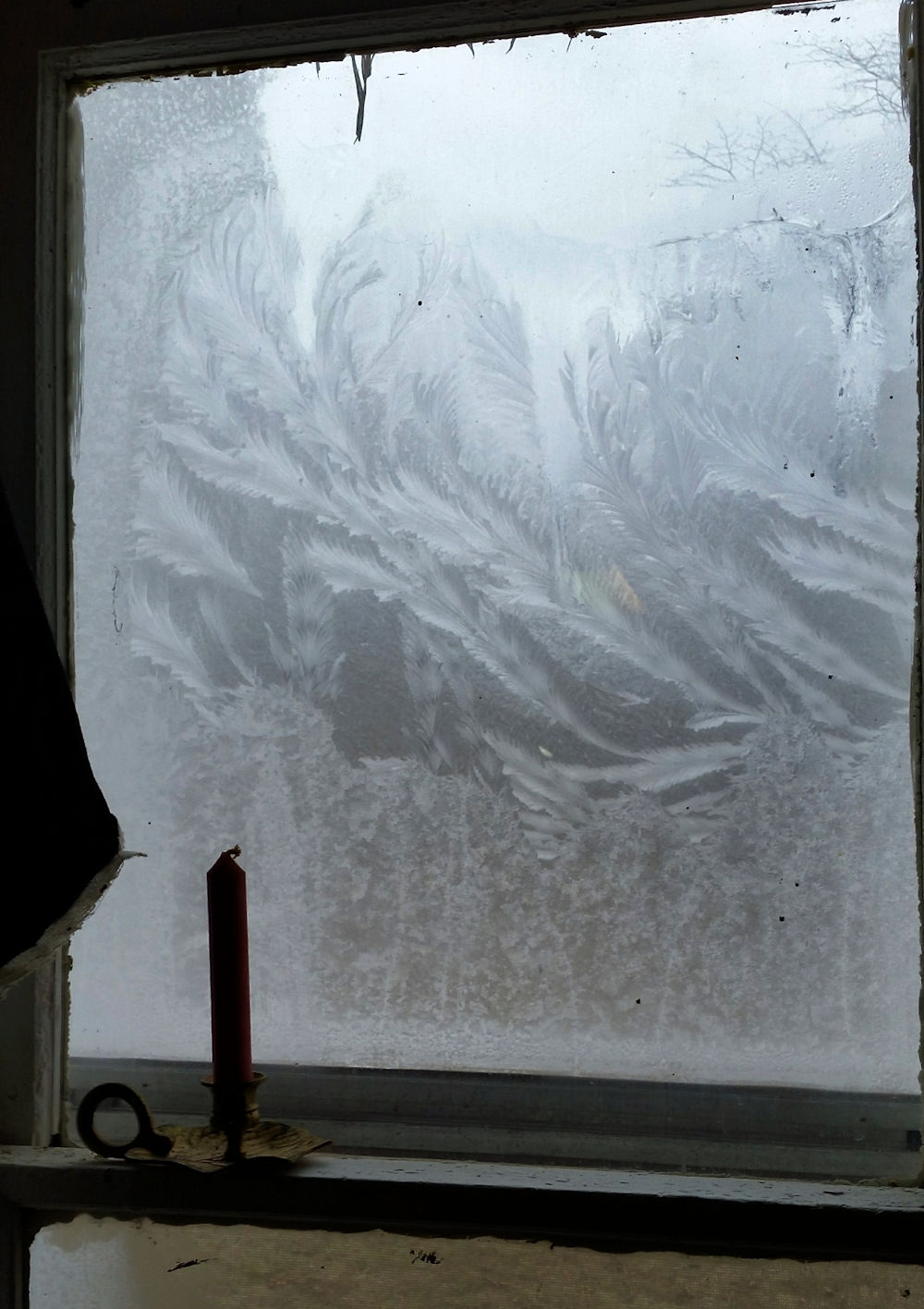
Jack Frost on my windowpane in the studio.
After a balmy winter holiday, the temperatures in the Midwest plummeted. We recorded minus 4 degrees (F) this week. Needless to say, I’m a wuss and am not spending much time outdoors. However, even working in my studio has challenges.
As I have mentioned before, my studio is an old summer kitchen about 30 feet from the back door. It was designed when cooking was done on wood-fired cook stoves (which it actually had when we moved here.) This was to keep the heat out of the house in the summer. You’ll find one of these buildings on many old farms in southern Indiana and throughout the Midwest and South. I am lucky that ours is about 15 x 25’, which is pretty large for a summer kitchen. In this case, the family and field hands actually ate in the building. It is a perfect size for a studio.
Unfortunately, the whole purpose of the design was to keep the heat out of the house so they didn’t really care about insulating the building. Thus, it’s very drafty. Although I have a gas heater, unless I want to go broke, I keep it turned down. This week I was wearing a hat, many layers of clothing, two pairs of socks (the cold comes up through the floor), and I was still chilly.
I snapped this photo of the beautiful patterns of the frost on the windowpanes. It looks like giant feathers. With all of our insulated windows and super-heated houses, window frost has become more and more uncommon.
The beauty of nature is all around us, even in the most unlikely places.
Since I was confined to studio painting, here are a couple of my recent works. Plus, I tweaked the still life with red cabbage and artichokes that I posted on here a few weeks ago. Artists are never quite satisfied with their finished work. Renoir was known to bring his paints to gallery exhibits even after his paintings were hung, just so he could make changes. I’m not quite that bad but I might fiddle around with a painting which doesn’t quite suit me.
Here’s hoping that the weather is better where you are and that warmer days will be here soon.
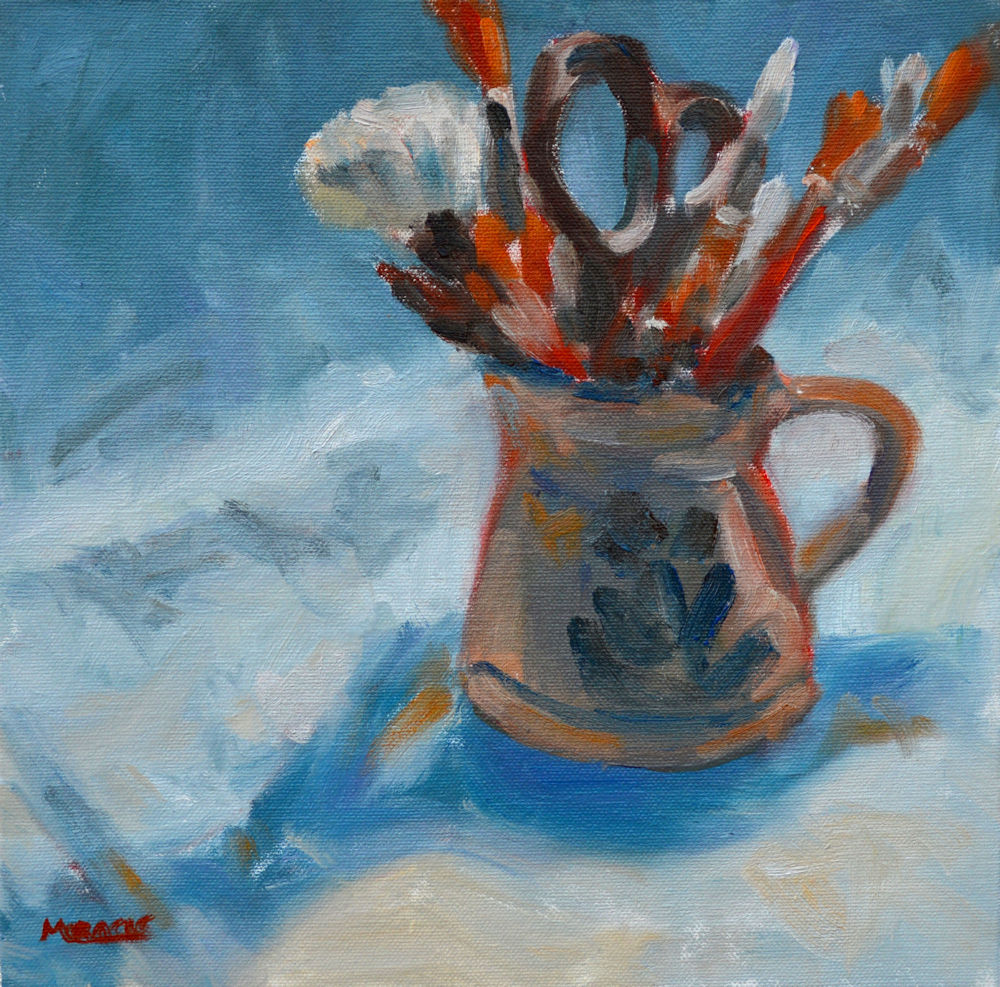
Artist Still Life, oil on canvas board, 10 x 10, Kit Miracle

Down by the Creek, oil on canvas, 20 x 16, Kit Miracle
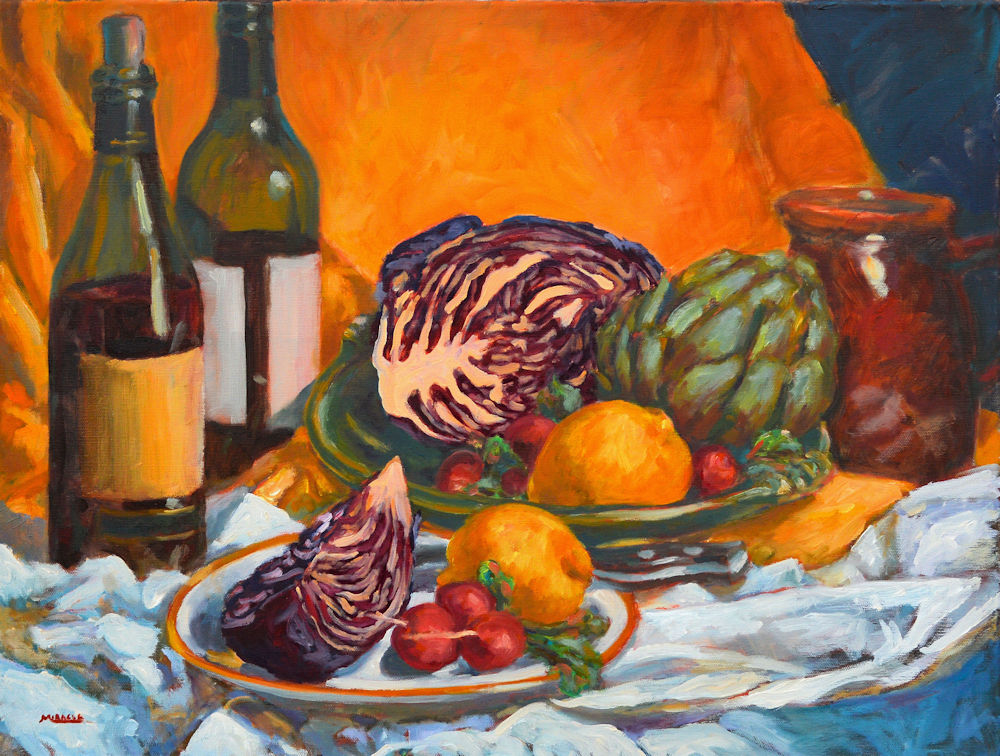
Red Cabbage and Artichoke, 18 x 24, oil on canvas, Kit Miracle. Still Life revised from previous version.
Comments Off on Jack Frost Visits
Posted in art, country living, old house
Tagged art, contemporary impressionist, country living, indiana, jack frost, kit miracle, oil painting, old house, still life
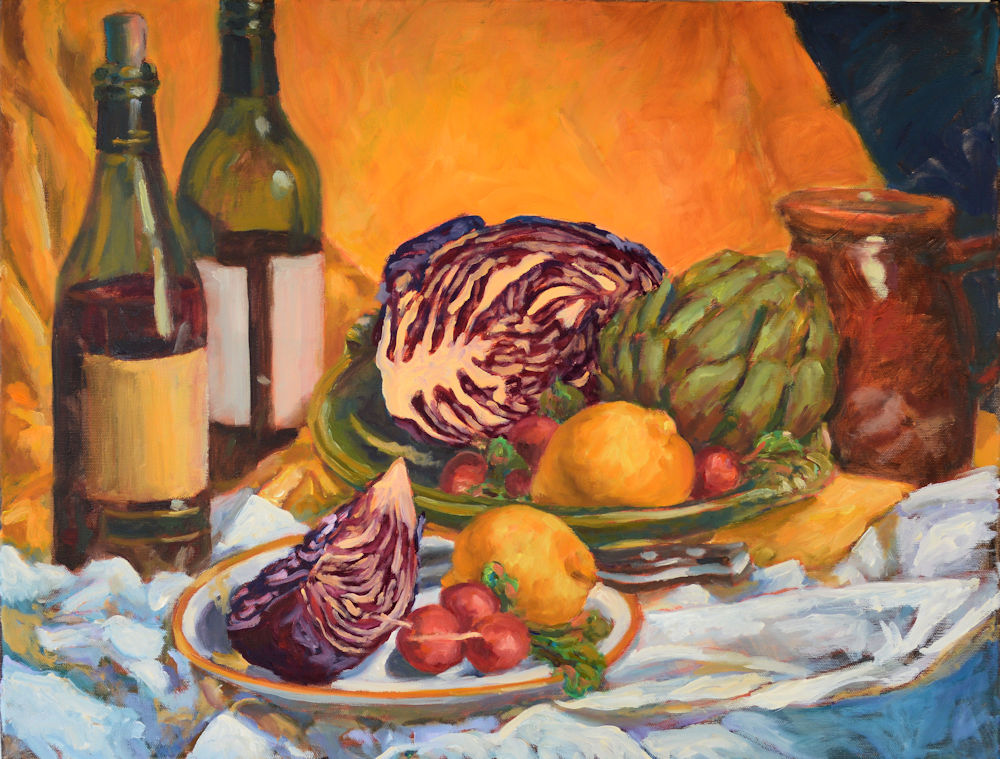
Red Cabbage Still Life, oil on canvas, 18 x 24, Kit Miracle
This still life is a little larger and more complex than many of my other recent paintings. I was inspired by a visit to the grocery. I must have had my “artist’s eyes” on that day because I seemed to be dazzled by the beautiful colors and shapes of the vegetables. Several of the more interesting vegetables came home with me that day.
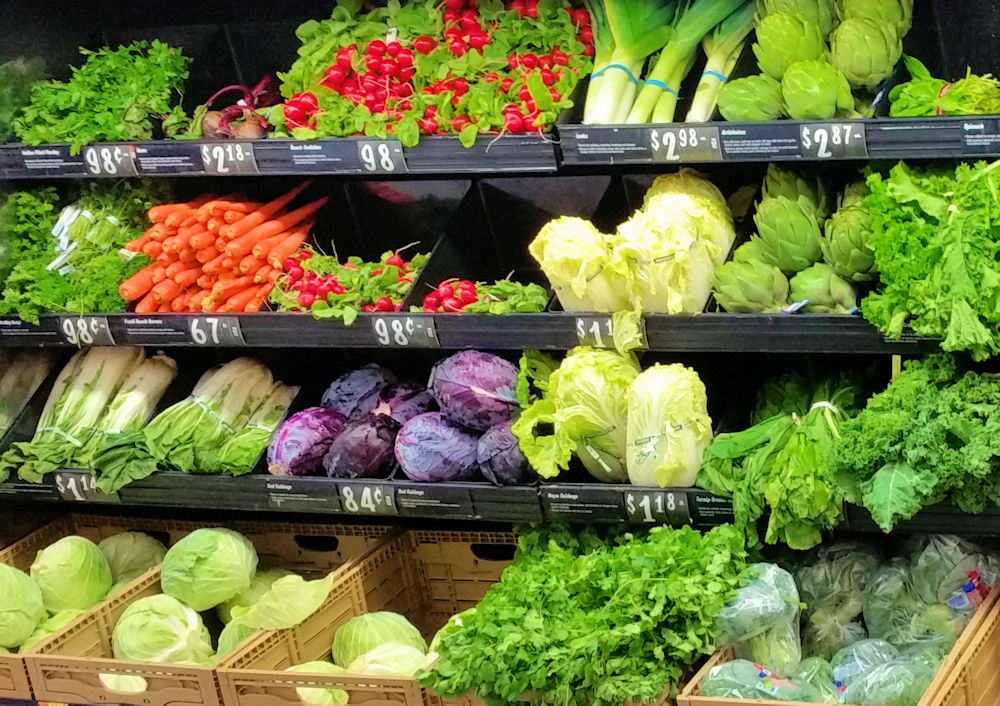
Inspiration in the vegetable department at the grocery. I love these colors and interesting shapes.
Before I tackled the main still life, I first completed several smaller still lifes just to get a feel for the shapes and colors.
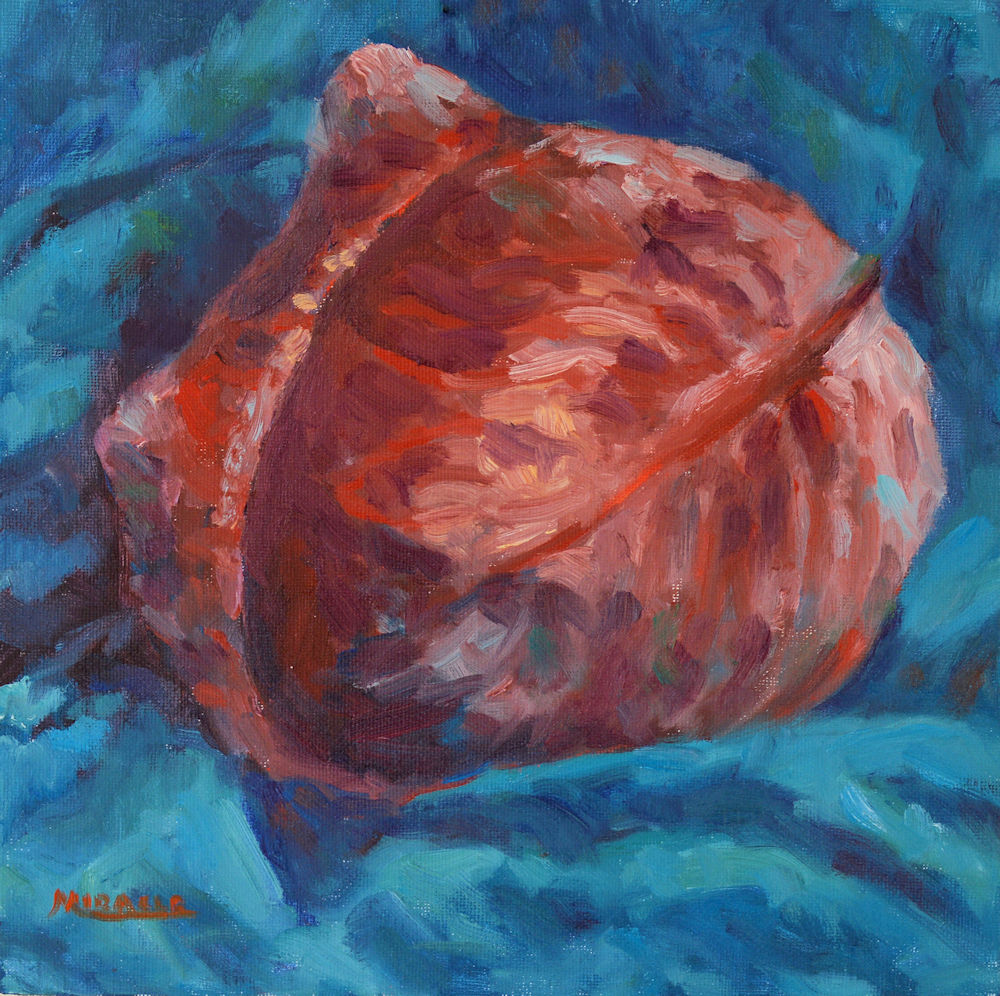
Red Cabbage, oil on canvas board, 10 x 10, Kit Miracle
Surprisingly, the red cabbage was the most difficult to paint. It has very subtle hues of purple, red and magenta. It was a tight head so not much interest as far as shape until I peeled back a leaf or two. I think a larger, leafier cabbage would be far more interesting.

Artichoke, oil on canvas board, 10 x 10, Kit Miracle
The artichoke, with it’s pointy leaves and shapes, was very fun to paint.
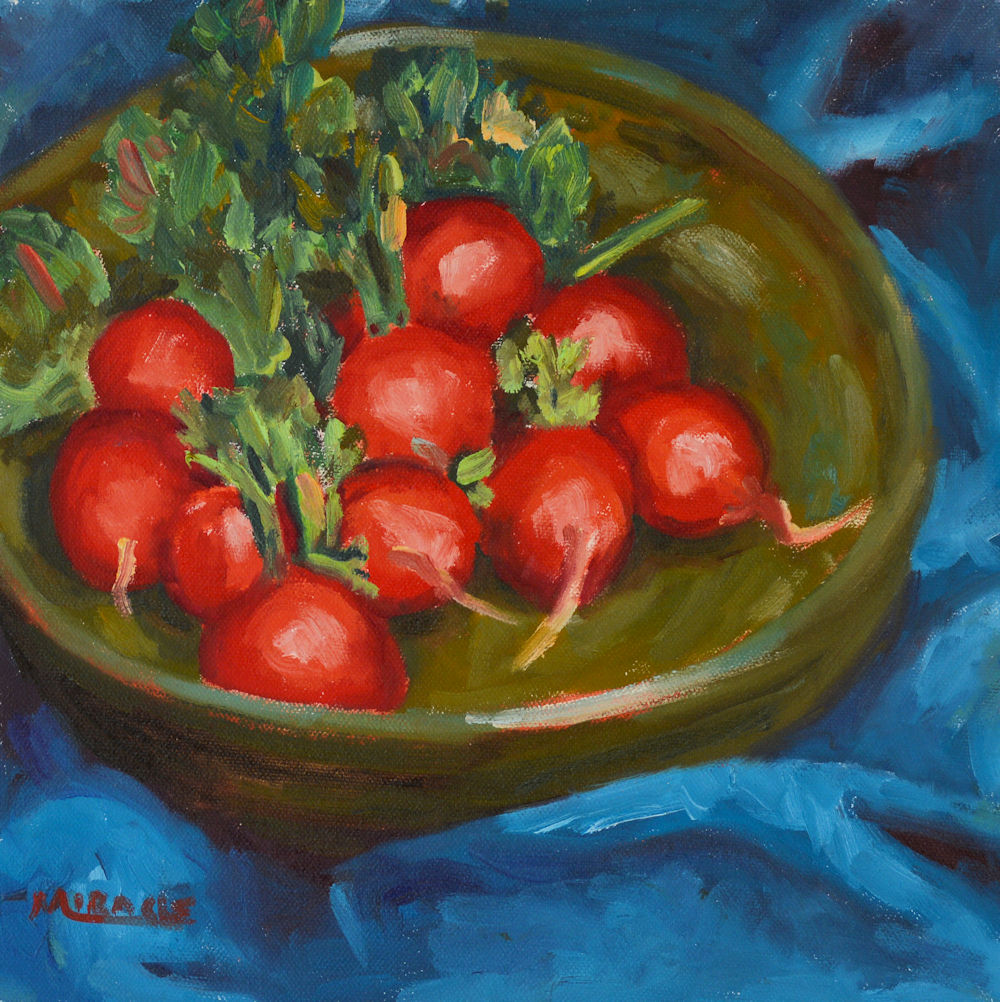
Radishes in Green Bowl, oil on canvas board, 10 x 10, Kit Miracle
The radishes are usually fun but their greens started to wilt quickly. However, they later generated more new leaves so that was a big help.
The final big still life was painted on an 18 x 24 inch canvas which I had toned in variegated colors. It seems to have a glow all its own. I don’t quite know how that happened except that some of the under painting showed through. Unfortunately, I didn’t’ take step-by-step photos of this painting. I might tweak it a bit more but there’s always a risk of going too far. Sometimes done is done.
These paintings will be for sale on my Etsy shop. KitMiracleArt
Comments Off on Red Cabbage Still Life – A Challenge in Color and Shape
Posted in art, oil painting, still life, Uncategorized
Tagged art, contemporary impressionist, kit miracle, still life, toned canvas, vegetables
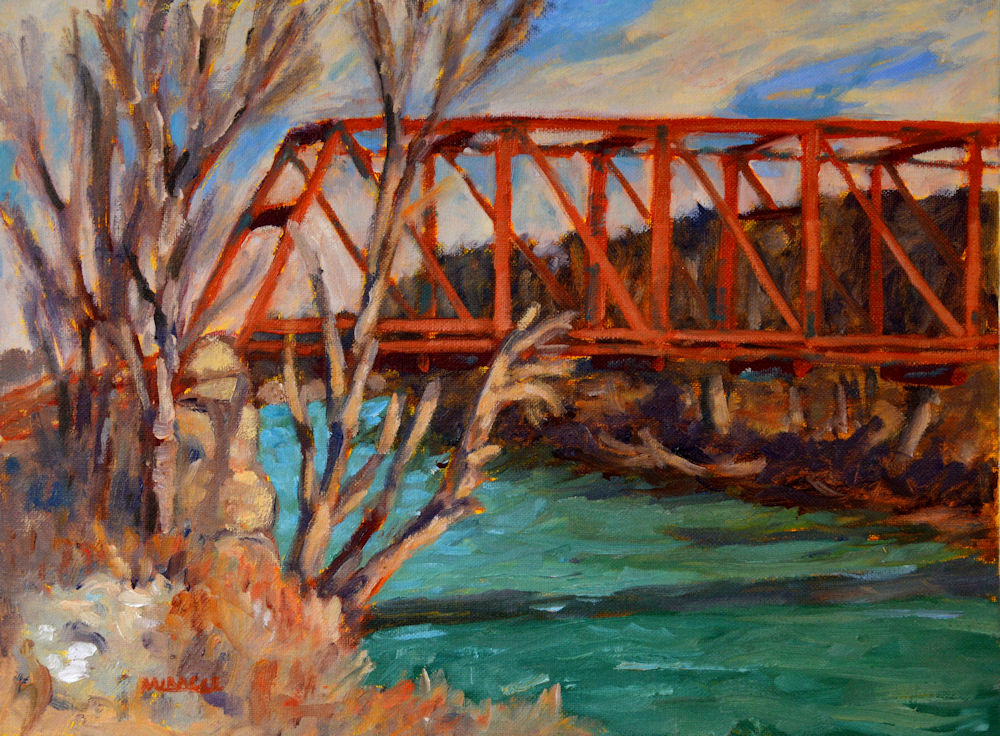
Plein air painting of Brooks Bridge, oil on canvas board, Kit Miracle
I went plein air painting with my friend Bill Whorrall on Monday. It was a beautiful and unseasonably warm December day with temps in the 60s. However, the wind was brisk which posed some problems later.
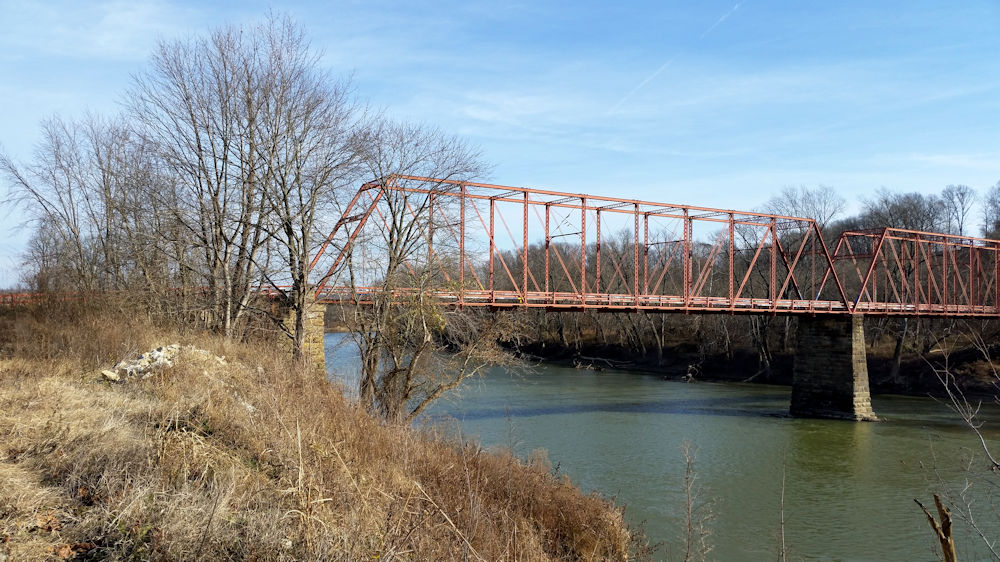
Brooks Bridge across the East Fork of the White River in Martin County, Indiana
Bill lives in Martin County, Indiana which is lovely and boasts a variety of terrains – rivers, stone ledges, hills, woods. We decided to paint this one lane bridge, Brooks Bridge, which spans the East Fork of the White River south of Shoals. We had spotted this location before but the ground was too wet to drive on.
While we were painting, we saw about four vehicles, including a four wheeler; probably the farmer checking us out. (It’s hunting season and there are lots of poachers.) I just waved and he drove back. The sparse traffic is probably why the bridge is only one lane. Yeah, impossible for you city people to believe but they still exist.
Bill was working on some ink drawings that he created with sticks and twigs as drawing instruments. You can see the results here. Really neat.

Plein air painting along the East Fork of the White River south of Shoals. My friend Bill Whorrall is drawing with ink and sticks.
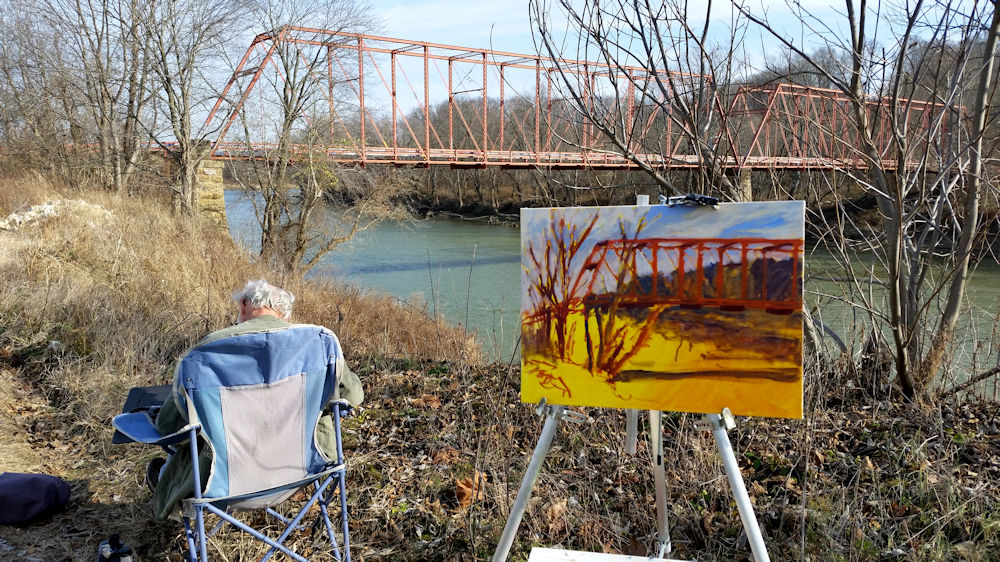
Painting half done
I decided to use a canvas panel toned with yellow paint. It was pretty bright but where it shows through, it seems to add some magic. I like it anyway.
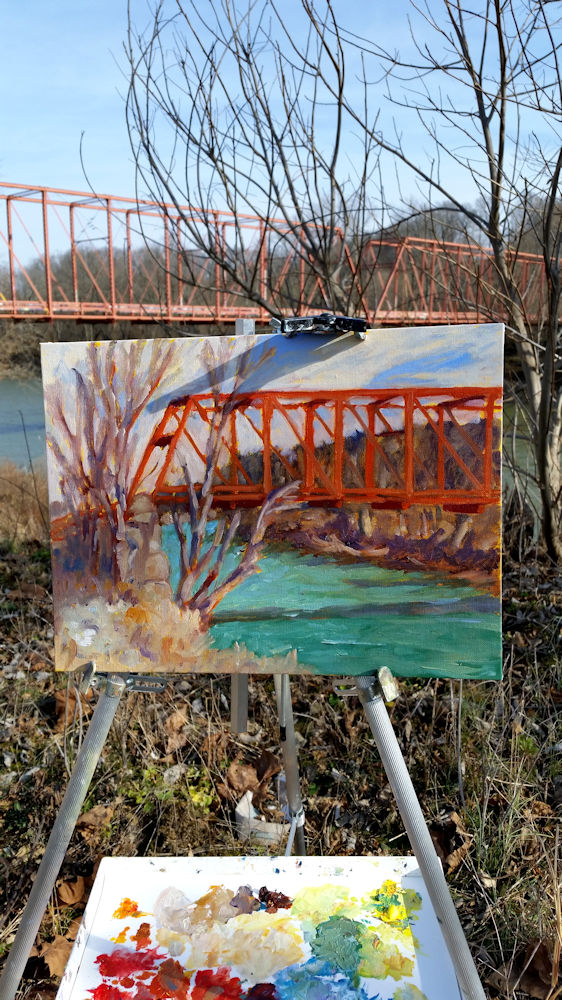
Plein air painting of Brooks Bridge. The wind nearly took my easel right after I took this photo!
The only real problem was that the wind picked up throughout the morning. A strong gust nearly knocked my easel into the river!
I tweaked the final painting in my studio, darkening the details and adding highlights. It’s sometimes difficult to really see and judge colors and contrasts in the bright sunlight. What do you think?
Yeah, it’s for sale at my Etsy shop.
Posted in art, oil painting, plein air painting
Tagged art, bridge, contemporary art, indiana, kit miracle, martin county indiana, plein air, shoals indiana, toned canvas
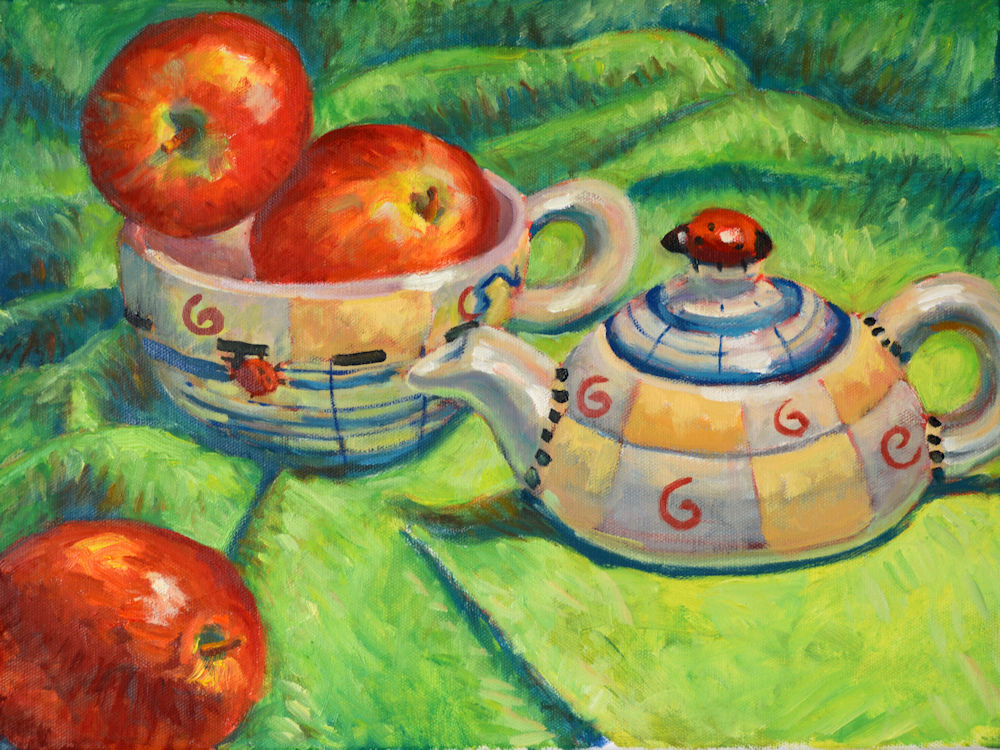
Ladybug Teapot, oil on canvas, 12 x 16, Kit Miracle
This playful still life was inspired by the whimsical ladybug teapot that I found in my prop cupboard. It’s actually a teapot and cup combination which I paired with some red apples and bright green fabric. Check out the step-by-step of how this painting was created here.
The painting can also be found on my Etsy shop, KitMiracleArt. A great gift for your favorite tea lover!
Posted in art, oil painting, painting instruction, still life, Uncategorized
Tagged art, contemporary impressionist, kit miracle, ladybug, oil painting, painting instruction, still life, tea lover, teapot
It was a busy week here on the farm with company and the big Thanksgiving feast. The weather has been pretty great, too – all sunshine and balmy temperatures. In November, this means more outdoor chores, such as, chopping firewood, cleaning gutters, etc.
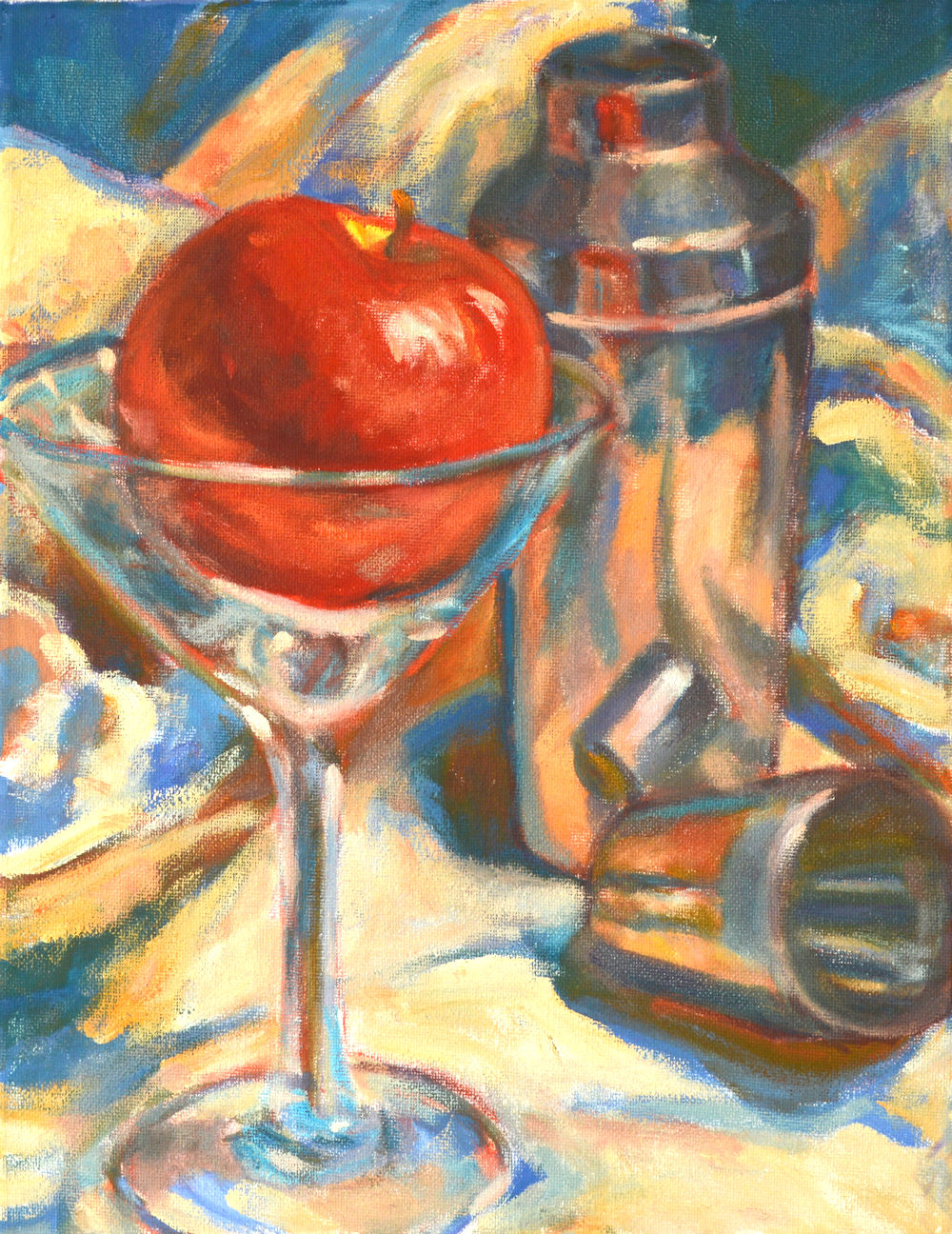
Appletini, oil on canvas, 16 x 12, Kit Miracle
All of these activities mean that I only completed one painting this week. I call it Appletini since it features a big red apple in a martini glass with a silver shaker behind it. The reflections were what really attracted me. This is similar to previous paintings that I’ve posted on here, Apple Jack, and Two Lemons and a Martini Glass. I don’t know why but I like placing objects in unusual situations. Props courtesy of Goodwill thrift shop.
I’m not quite sure if I’m finished with the painting but I probably am. What do you think?
Of course, available on my Etsy shop and can be shipped in time for the holidays.
Comments Off on Appletini – Something Different
Posted in art, contemporary impressionism, still life, Uncategorized
Tagged apples, art, contemporary impressionist, Etsy, impressionism, kit miracle, oil painting, still life


 my90acres