Tag Archives: oil painting

Lucky Red

I don’t know quite why I started this painting but it’s something that has been rolling around in my head for awhile.  Sometimes I’ll think about a work for years before I get around to painting it.

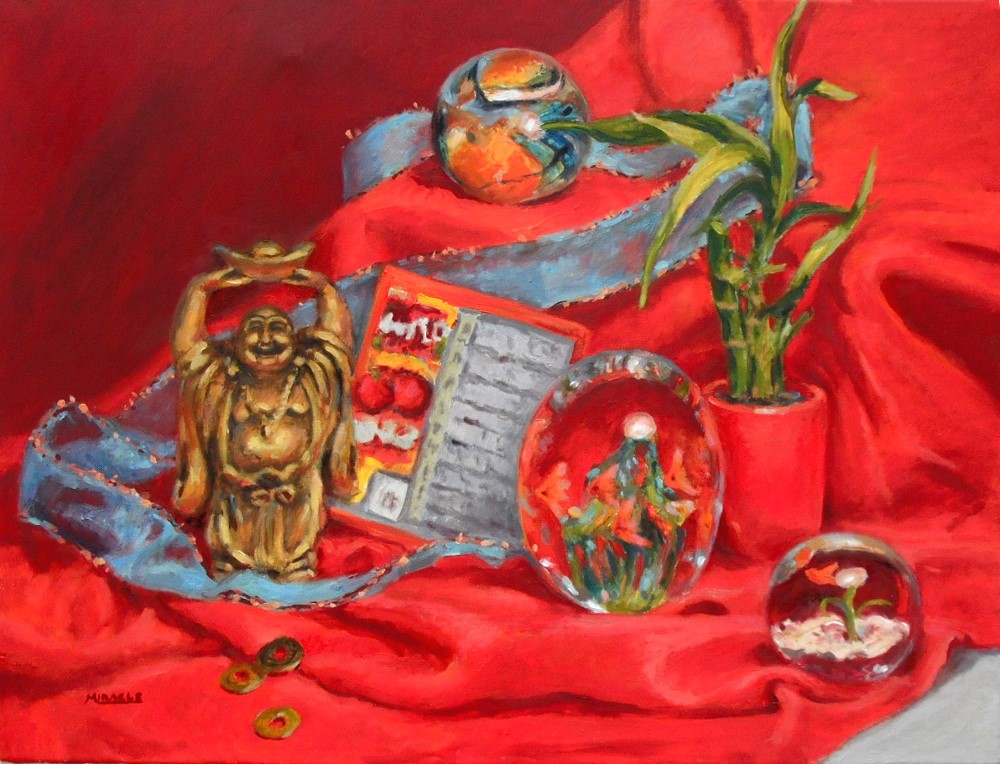
Lucky Red is a challenge of red on red on red.  Shiny and soft.  Clear objects, reflective, see-through.  Some of the symbols are pretty obvious.  The lucky Buddha, three Chinese coins, a WINNING lottery ticket.  Some are less obvious.  The lucky bamboo plant.  Two of the glass paperweights have fish swimming in them.  Fish are a lucky Chinese symbol.  And swirling throughout the still life is a lucky blue ribbon that I won at a holiday party.  (Thank you, Joan!) Topping the set up off is another glass paperweight called Mediterranean which celebrated the completion of a bike ride through France several years ago.

We all have lucky symbols in our lives.  What are yours?

Lucky Red - the initial still life set up

Lucky Red – the initial still life set up
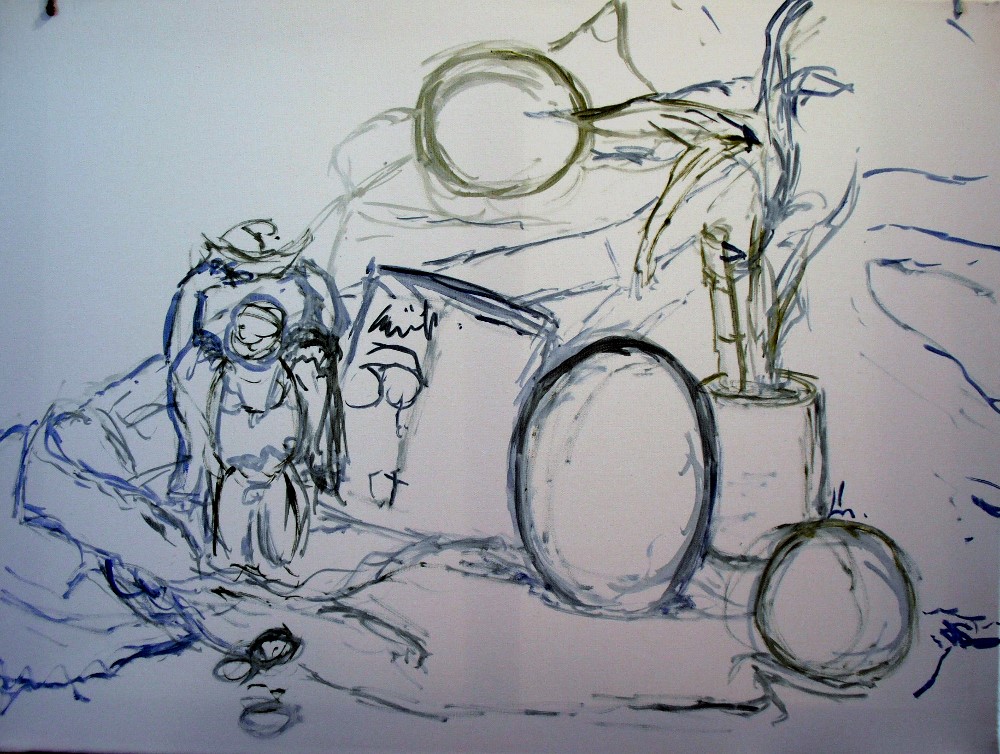
First step, drawing on the canvas
First step, drawing on the canvas

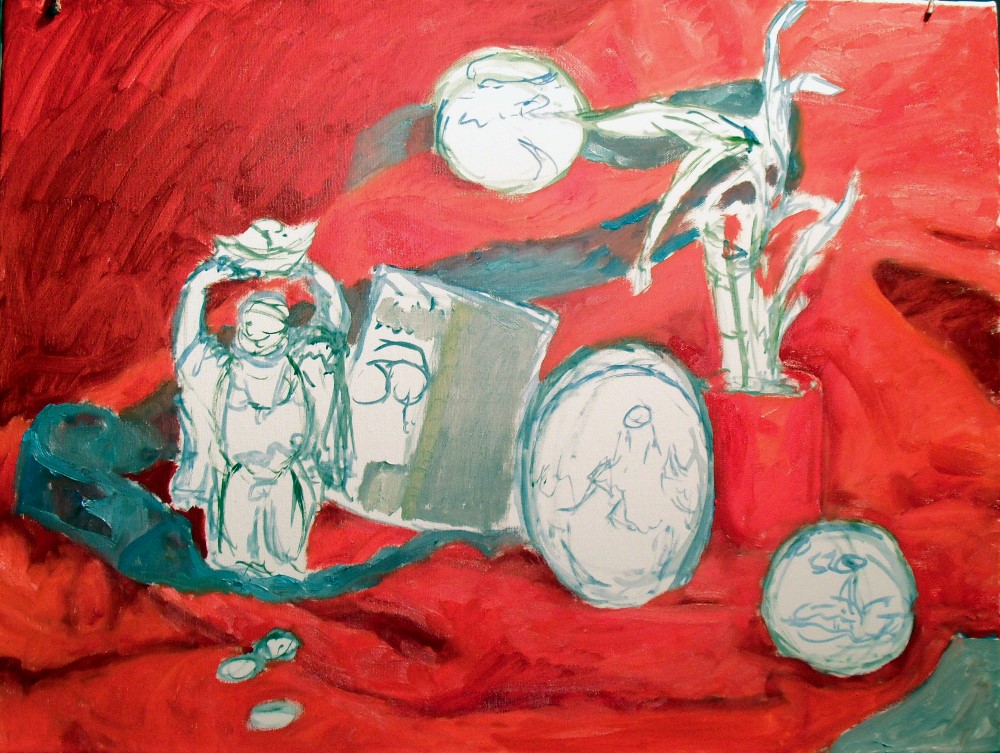
Second stage, blocking in major shapes
Second stage, blocking in major shapes

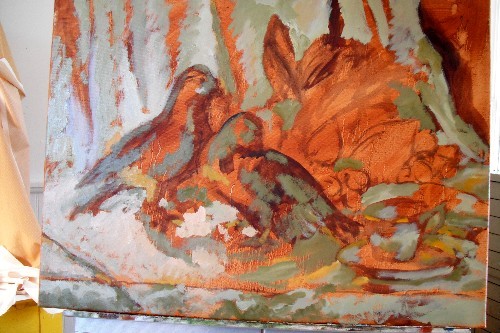
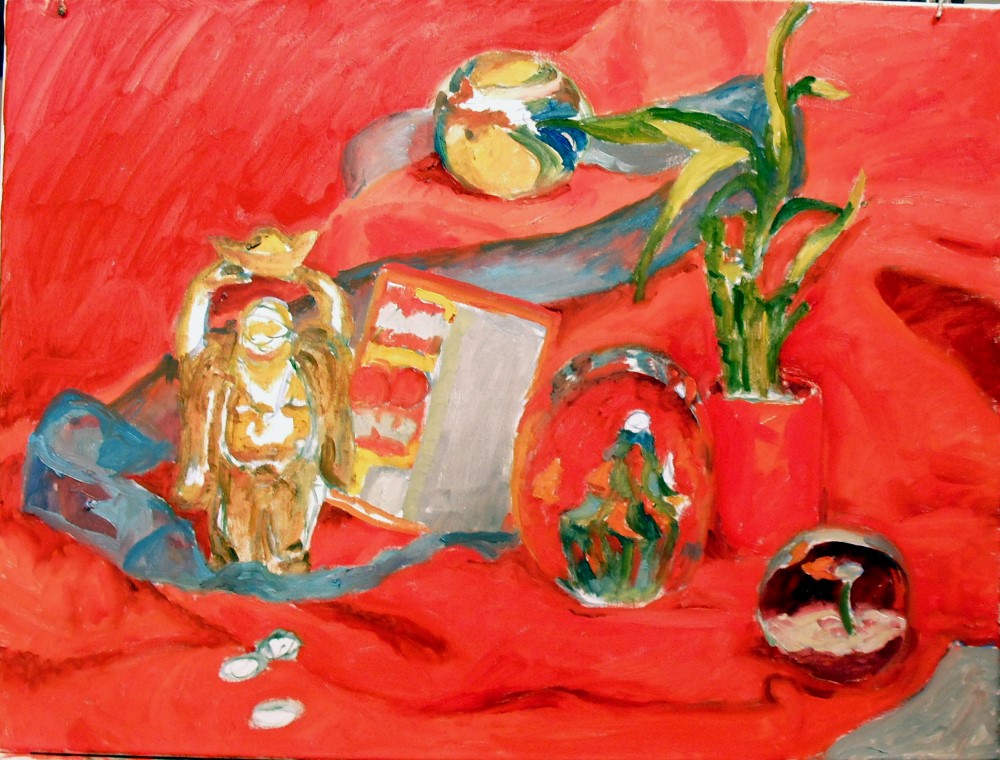
Third step, laying in base colors of the objects

Third step, laying in base colors of the objects

Fourth stage.  Almost finished.

Fourth stage. Almost finished.

What my palette looks like with a variety of reds.  Using black to tone some of them down.
What my palette looks like with a variety of reds. Using black to tone some of them down.

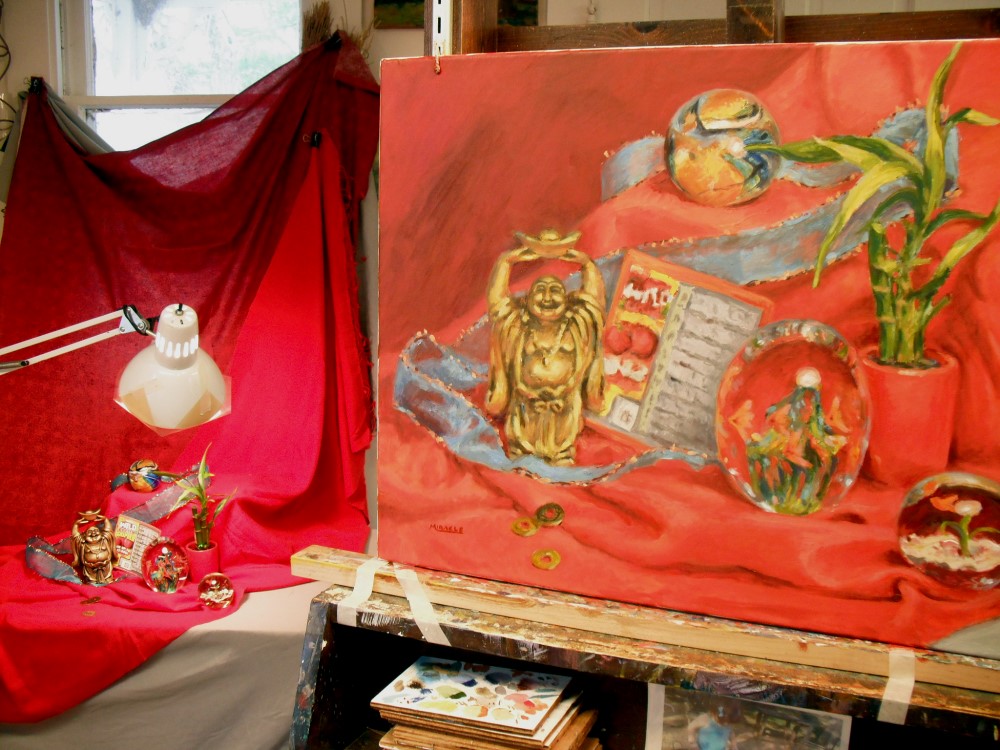
The painting compared with the still life.  Notice the gel I have taped over the light.
The painting compared with the still life. Notice the gel I have taped over the light.

Lucky Red, final.  Oil on canvas, 18 x 24, Kit Miracle
Lucky Red, final. Oil on canvas, 18 x 24, Kit Miracle
Silver on Grey – Oil Painting

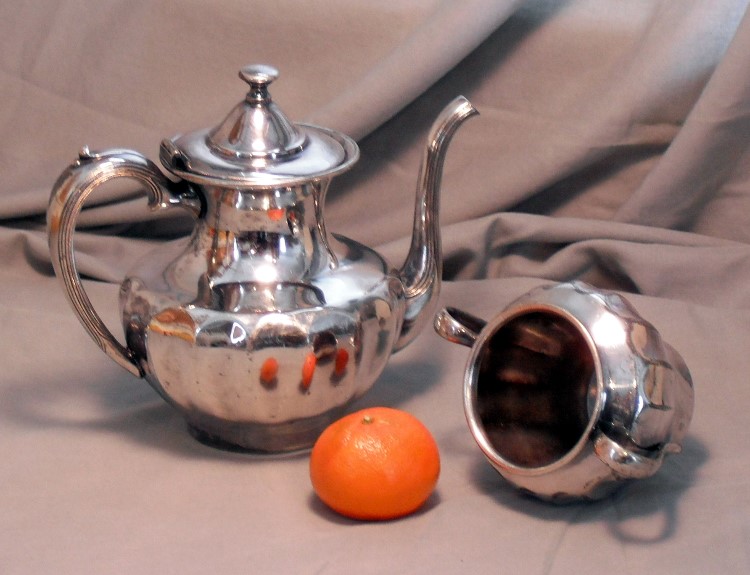
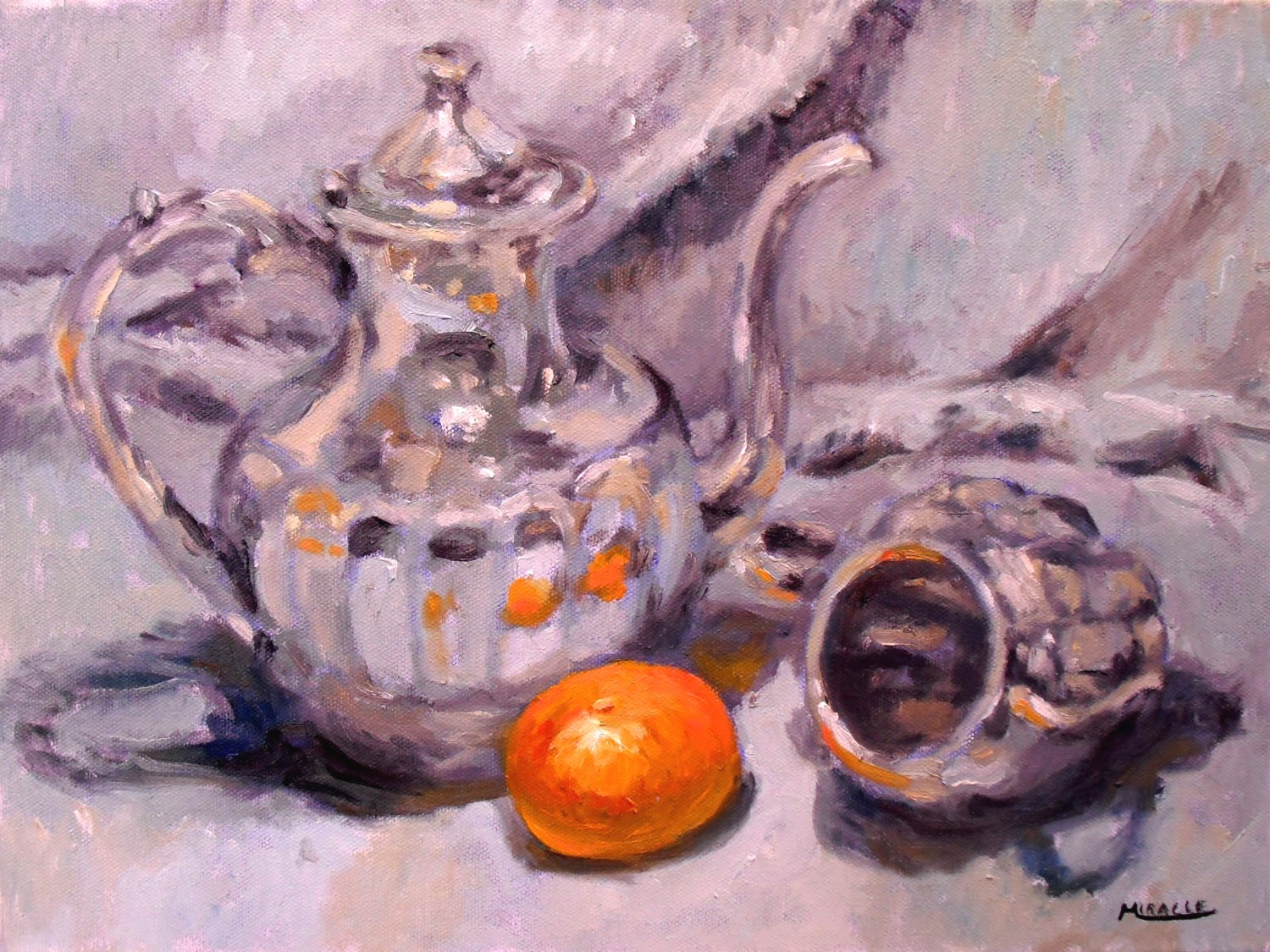
Last week I posted my silver teapot find from the flea market.  I just completed this oil painting to demonstrate the fun of dealing with reflections of shiny objects.  This will probably become a favorite still life subject in the future.

Silver on Grey still life set up

Silver on Grey still life set up

Silver on Grey, oil on canvas 12 x 16, Kit Miracle

Silver on Grey, oil on canvas 12 x 16, Kit Miracle

What is your painting style?

At some point in your painting career, you’ll wonder if you’ve got a painting style.  Would someone be able to point to one your paintings and say, “Oh, that’s a John Smith!”  It’s always nice to be known for a certain style but many of us find it difficult to recognize our own.  The following are some of my thoughts and observations about this.

  • Your style is like your signature, a certain way of handling your materials, your brush strokes, maybe your palette, or your subject matter.
  • It may take years to develop a recognizable style.  In the meanwhile, most artists experiment with many types of painting, often copying our favorite painters.  This is a great way to see what excites you and to test the waters.  How did Monet capture that light?  How did Picasso make the most of his materials?  Eventually you’ll find a style that suits you.
  • Your style may…and probably will…evolve over time.  It’s pretty unusual for an artist to find one particular way of painting and to never change again.
  • While your work may change over time and while you are having fun learning how other painters create, at some point it’s a good idea to focus on one style for a while.  When an artist shows me a portfolio with a mishmash of subject matter, techniques, and mediums, and who exclaims, “I can paint anything!” the first thought I have is “amateur.”
  • You need to focus.  What are you passionate about?  What is your emotional connection?  What reaches into your chest and grabs your heart?  That is what you need to paint.  At least for a while.
  • Build up a body of work.  Do maybe twenty paintings that are similar in technique, subject matter, medium, etc.  Some people say to create as many as 100, which seems a little excessive to me but, well, whatever works for you.  You just need to prove that you have the tenacity to focus to create a body of work.
  • Stand your paintings around the room and ask a trusted friend, preferably a knowledgeable artist or teacher to give you their honest opinion.  How would they describe your work?  What are its strengths, weaknesses?  Close relatives are usually not good at this because they love everything you do.  And beware of someone who may have an ax to grind.  You definitely do not need their opinions to undermine your self-confidence.
  • Listen to what they say.  If someone says, “That’s an awful lot of yellow in your work,” maybe you need to reevaluate.  Or if you’re aiming for super realism, and your friend says, maybe the shape on that bottle could be worked on, that means you need to work on your drawing skills some more.
  • And finally, as I have said before, be kind to yourself.  Your work is continually evolving and that’s OK.  You may still be sailing for the horizon which continually moves beyond you.  Sometimes you need to stop and take a reckoning of how far you’ve come already.

There is a lot of other advice about how to identify or create your style, but these tips will provide you with the basics.  Please let me know if this posting is helpful to you or if you have any other questions.

Pecos River Valley, Step-by-Step

Pecos River Valley, final, oil on canvas,  18 x 24,  Kit Miracle

Pecos River Valley, final, oil on canvas, 18 x 24, Kit Miracle
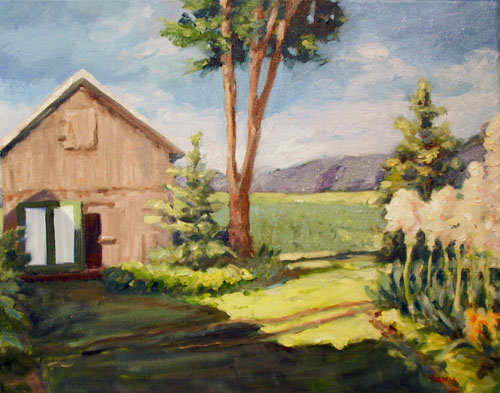
As much as I loved Arizona, I was also enamored with New Mexico and the Pecos River Valley.  I spent one day at the ruins of the Pecos Indians which are preserved as a national park now.  From the top of the area, I could see for miles.  This is one view of the Pecos River Valley. https://my90acres.com/artwork/pecos-river-valley-step-by-step/


Sedona Hills at Sunset

Sedona, final, oil on canvas, 15 x 27, Kit Miracle

Sedona, final, oil on canvas, 15 x 27, Kit Miracle

I fell in love with the red hills in Sedona, Arizona on my recent visit there.  This is a long painting, 15 x 27, which represents the landscape at sunset.  Just north of Bell Rock at sunset.  Check out the link for a step-by-step. https://my90acres.com/artwork/sedona-hills-at-sunset-step-by-step/

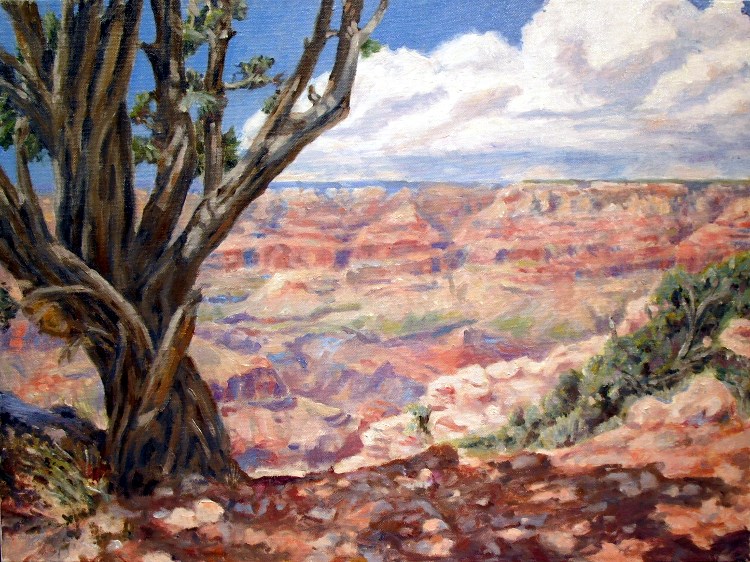
Grand Canyon – Moran Point

Grand Canyon Moran Point - Final  18 x 24 oil on canvas

Grand Canyon Moran Point – Final 18 x 24 oil on canvas

I visited the Grand Canyon last month for the first time and fell in love with the place.  I could paint there for a hundred years and still not run out of subject matter.  What I loved most…and which was most challenging to me as a painter…is how the view changes constantly, depending upon the time of day and weather.

This demonstration is from the famous Moran Point, named after Thomas Moran.  I sat under this tree and painted a nice little watercolor but the actual painting was completed in the studio.  For once, not on a toned canvas.  Check out the demo at the link below.  https://my90acres.com/artwork/grand-canyon-moran-point-demonstration/

new eyes

Sometimes it takes a little nudge to get us out of our ruts. I’m currently traveling in the southwest with a bunch of canvases and paints. They say that travel is good for the soul. All I can add is that it makes me see the world with new eyes.  I love the colors, the vistas, the entire flavor of this part of the world.  This is a photo taken as I was perched on the edge of the Grand Canyon. I also spent several days painting the red rocks of Sedona.  Now I’m in Santa Fe. I’ve discovered that it’s best not to look at the work of too many other artists as I lose focus on my own vision. I brought 19 canvases and intend to return with 19 paintings.  Of more or less achievement. Stay tuned.Image

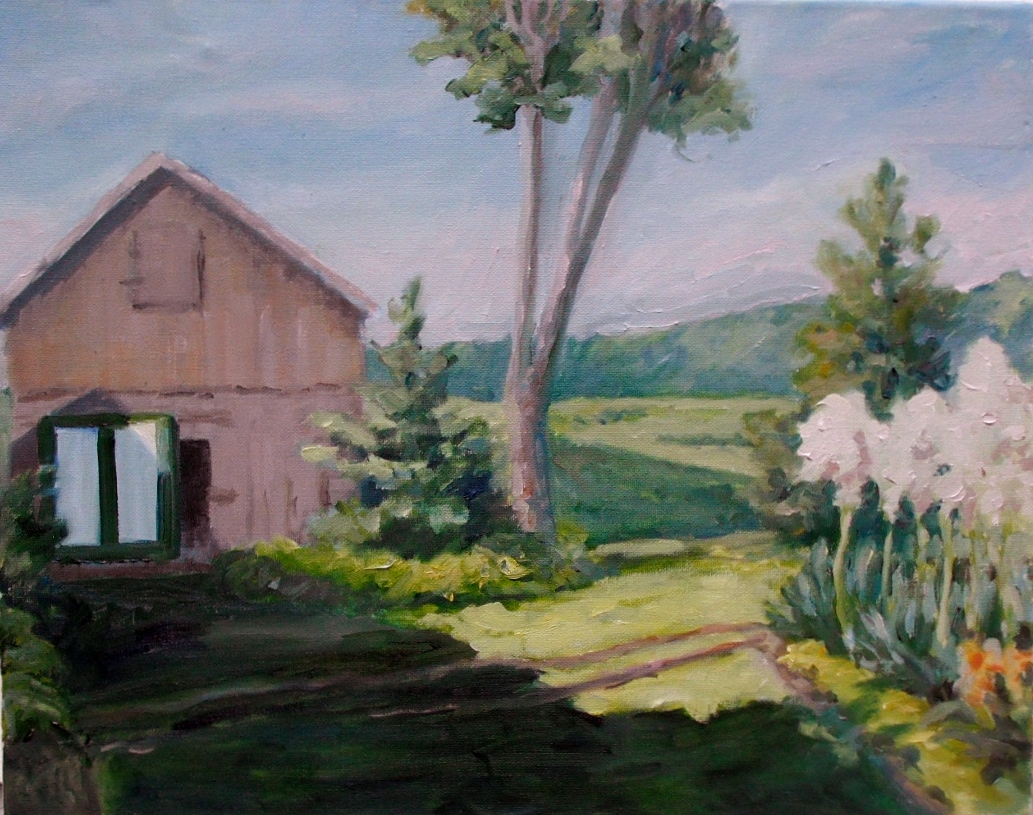
Improving a Painting

Blessinger Farm revised.  Oil on canvas, 16x20

Blessinger Farm revised. Oil on canvas, 16×20

The first pass at the Blessinger farm painting.

The first pass at the Blessinger farm painting.

Sometimes when I finish a painting it seems OK, but….something is not quite right. That’s when I let it sit on the easel for a while. Such is the case with the one that I posted here a few weeks ago, Blessinger’s Farm. After examining it for several days, I realized that several improvements could be made.

First of all, the tree was right in the middle of the painting. This is very poor composition as it divides the canvas in half. It was also a weird looking tree but that may have more to do with the fact that a tornado blew through the farm a few years ago wiping out 80 year old maples. Nevertheless, I decided to move it closer to the barn (easy to do in paint, right?) and to juice up the colors. I also decided to push the background way back. Too much green. And to clarify some of the focal points. What do you think?

A Little Blue (on a Rainy Day) demo

A Little Blue (on a Rainy Day) Final, oil on canvas, 24 x36

A Little Blue (on a Rainy Day) Final, oil on canvas, 24 x36

This is a very complex still life that I recently completed. Check out the demo on the linked page. https://my90acres.com/?page_id=330&preview=true

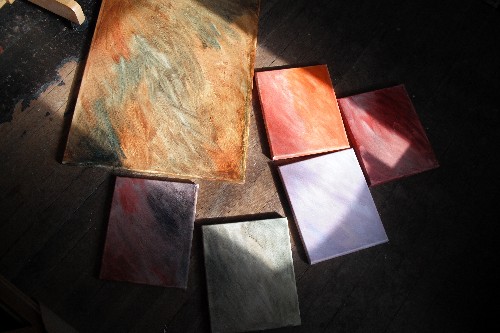
How to tone a canvas

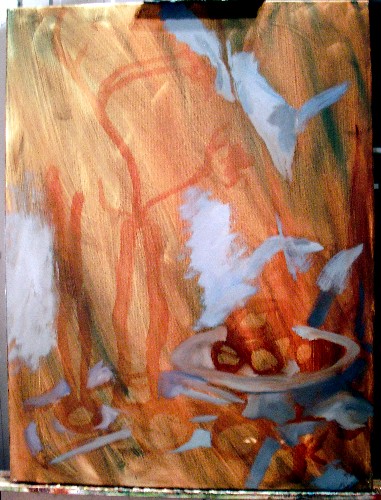
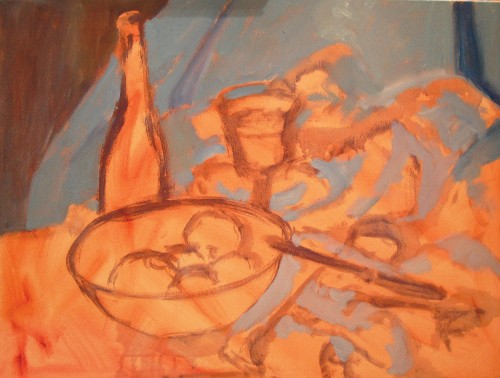
TonedcanvasIn an earlier how-to post, I told you about the why of using a toned canvas but I thought I’d review that again.

Using a toned canvas takes away the fear and indecision of painting for many artists. You already HAVE something on the canvas. Mostly when you’re painting, you’re using push-pull. That is, pushing the background into the back, and pulling the foreground up front. You see this more often with artists drawing on toned paper, such as, pastel artists. This is a very old technique, maybe centuries old.

I like it because it seems as if the tone color (whatever I may have chosen) fills in the broken spaces of my paintings. A search on the internet will turn up quite a few artists who use this technique.

Most of the time, I will take leftover paint at the end of a session and tone a bunch of canvases just to have them on hand. Although I do not use this technique all the time, it’s great to be able to grab a few canvases as I’m heading out for some plein air painting. I just seem to be able to get a head start on getting the basics down. However, you can do this on location with just rubbing in some local colors with a rag. It’s entirely up to you.

My preference is for warm colors or even some very dark colors but I have used many – burnt sienna, dark brown/grey, blues, greens and even purples (yuck). One artist I know, Caroline Jasper, uses red for her canvases which adds an element of sparkle, and Wyatt LeGrand uses some very dark tones which also works well for him.

If you haven’t tried this technique, just try it for a few times to see how you like it.

Stilllifesetupbluebottles150step1

Tonedcanvas4

Tonedcanvas3

Tonedcanvas2