Posted onNovember 26, 2023|Comments Off on 125th Annual Juried Show – Richmond Art Museum
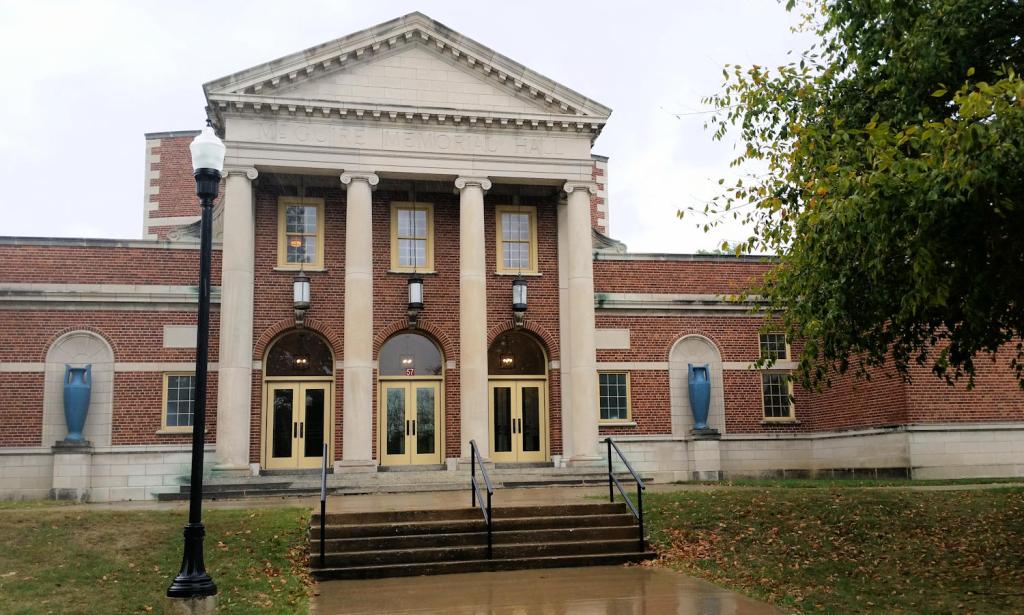
McGuire Hall, Richmond Art Museum, Richmond, Indiana.
I mentioned in a post a few years ago (October 2019) that my high school alma mater is in Richmond, Indiana. It is a beautiful and stately old school with many new additions over the years. What most people don’t realize is that it is one of the few public high schools in the country that has it’s own art museum attached.
As a student there, I walked past famous paintings every day on my way to class in the arts wing. I thought that every high school had an art museum. I didn’t learn until much later how unusual this situation was. I’m sure that walking through beautiful McGuire Hall had a definite impact on my eventual career path. It was very inspiring seeing real paintings by William Merritt Chase and T.C. Steele on a daily basis.
Richmond Art Museum still receives enormous community support. They are currently celebrating their 125th annual juried exhibition for artists living in Indiana and Ohio. I am very pleased to report that I had both of my entries accepted into this prestigious show. The two paintings are The Golden Marble and Leo’s Muse which I’ve discussed in earlier posts.
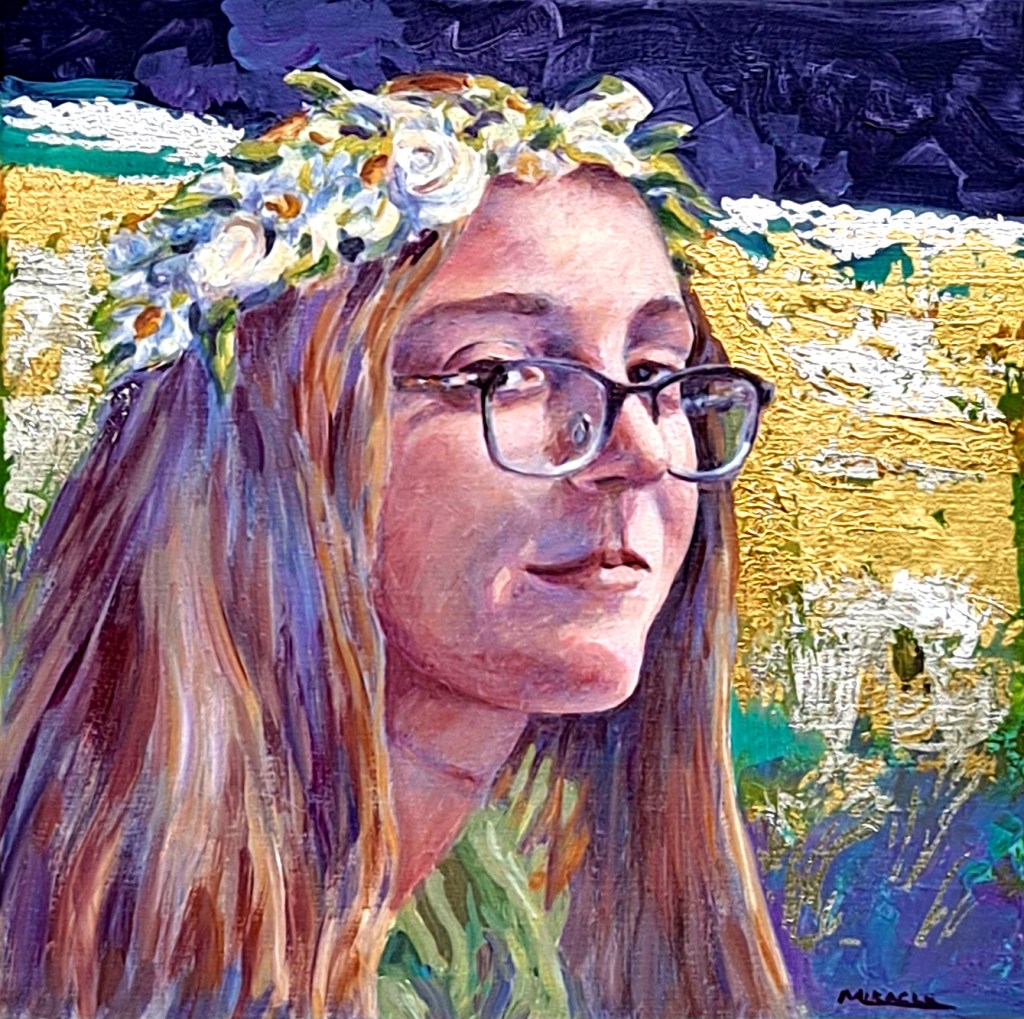
Leo’s Muse, final, acrylic on canvas, 23K gold leaf, sterling silver leaf, 16 x 16, Kit MiracleThe Golden Marble, acrylic on canvas, 30 x 24. 23K gold leaf and sterling silver leaf. Kit Miracle
If you’d like to see the paintings in person and many other beautiful works, the exhibit runs through January 6th, 2024. The museum is located on the north end of Richmond High School on Hub Etchinson Parkway where there is public parking. Admission is free. Feel free to stop in, see the exhibit and some of the artwork on display in the other galleries. Hours are Tuesday through Saturday, 10 to 5; closed Sunday, Monday and major holidays. Call 765-996-0256 for more information.
This is the time of year when people gather together in homey places. Basements, dens, shops, barns. Places with warm stoves and fireplaces, indoors or outdoors, as weather permits. Shared food and snacks, tall tales, laughter and fun.
Typical buck in velvet captured on the deer cam a few years ago.
I’m not talking about Thanksgiving. I’m talking about the opening of deer season which was yesterday in Indiana. This is with firearms. Bow season has been open for a awhile already.
Oh, those poor Bambis!, you say. I probably thought that over 35 years ago when I lived in the city. Now that I’ve lived in the county for most of my life, I have an entirely different perspective. Long gone are the days when my Uncle Elmer Ray would go hunting in the UP in Michigan, bring back the deer he bagged, then drive around with the poor victim strapped across the hood of his car. It always tasted a little wonky to me. Wonder why?
Not only did I feel sorry for the poor deer, when I moved to my90acres, I didn’t worry about the deer roaming around the property. Hummmm…. After they’ve eaten rows of green beans, new pea sprouts, or my flowers, I’ve got a different viewpoint. They don’t have much respect for what is my territory and what is their space.
But what really changed my opinion over the years have been the ELEVEN deer / car run accidents my family has had over the years. Plenty of expense and at least one car totaled. No injuries, fortunately.
The white tail deer population was mostly wiped out in Indiana by the early 1900s. It was reintroduced in the 1940s. Now, there are an estimated 680,000 deer here. Unfortuntely, having large wild animals roaming freely means that Indiana also saw more than 14,000 deer / vehicle accidents last year. That translates to 1.5 M across the US. This translates further to 1 B damages and around 200 fatalities.
Look carefully at the bottom of the photo to spot numerous deer tracks in the mud.
I’m not going to discuss the pros and cons of hunting season, but here are some things to keep in mind from becoming a statistic if you have to travel through rural areas. And by the way, the deer population is pretty strong in urban areas, too. This information is not scientific so draw your own conclusions. But I used to drive to work on country roads for a minimum of 250 miles per week for many years. These are some of my conclusions.
If you see dead deer along a certain stretch of the road consistently, consider that an unofficial deer crossing. They will often use the same paths over many years. Be aware. I saw one trying to cross the road in such a place just this past Friday evening. I was driving rather slowly (50 mph, probably to the annoyance of the car behind me) when a young buck appeared on the side of the road. I laid on the horn and the brakes; fortunately he turned around and went back but he looked as if he was going to run out in front of me.
They like to move at dawn and dusk but don’t let your guard down. I’ve seen them roaming at all times of day and night.
I’ve noticed that where a tip of woods touches the road with another tip on the other side, you’ll often see deer crossing. They’re using the cover of the trees.
Same goes for drainage ditches. They’ll take cover running along in the ditch, then pop up where the road crosses. Surprise!
They often run in groups. I’ve braked for a deer running across the road, then drove on, only to see in my reaview mirror the car behind me hit another animal in the herd.
Those are just a few hints to help you avoid becoming a statistic. Just use caution this time of year. Avoid feeding times, use your high beams, if possible. Slow down a bit. It just might save you a lot of aggravation down the road.
Just a note. The hunters around here are not just seeking trophies (although there is some bragging for that nine-pointer), but they actually use the meat for the table. Many hunters even share with local food banks and other organizations of need.
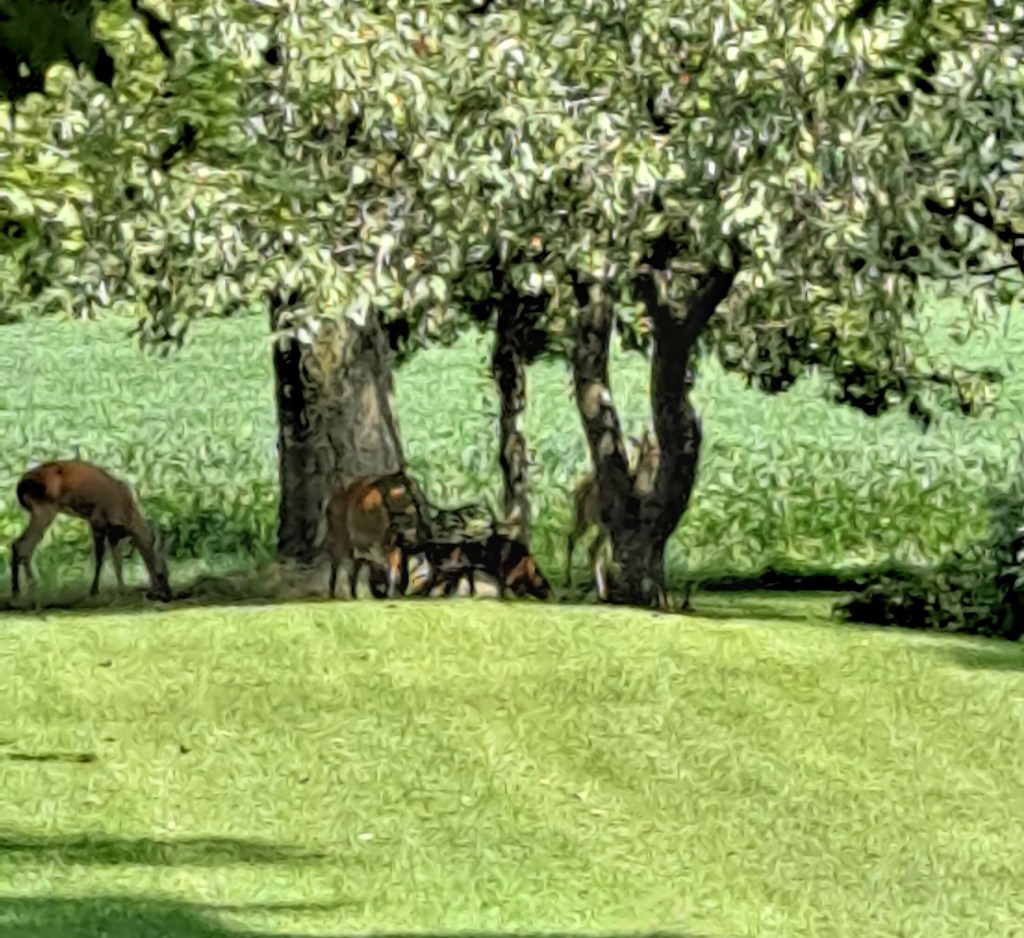
Afternoon visitors. They’re eating fallen fruit from the orchard.
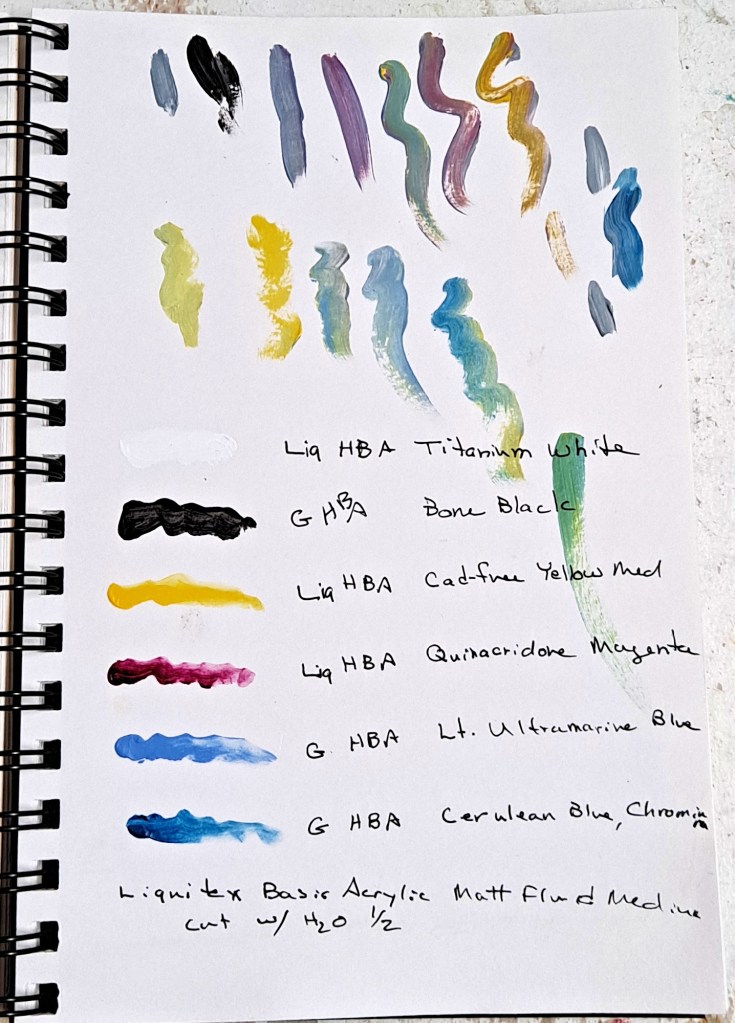
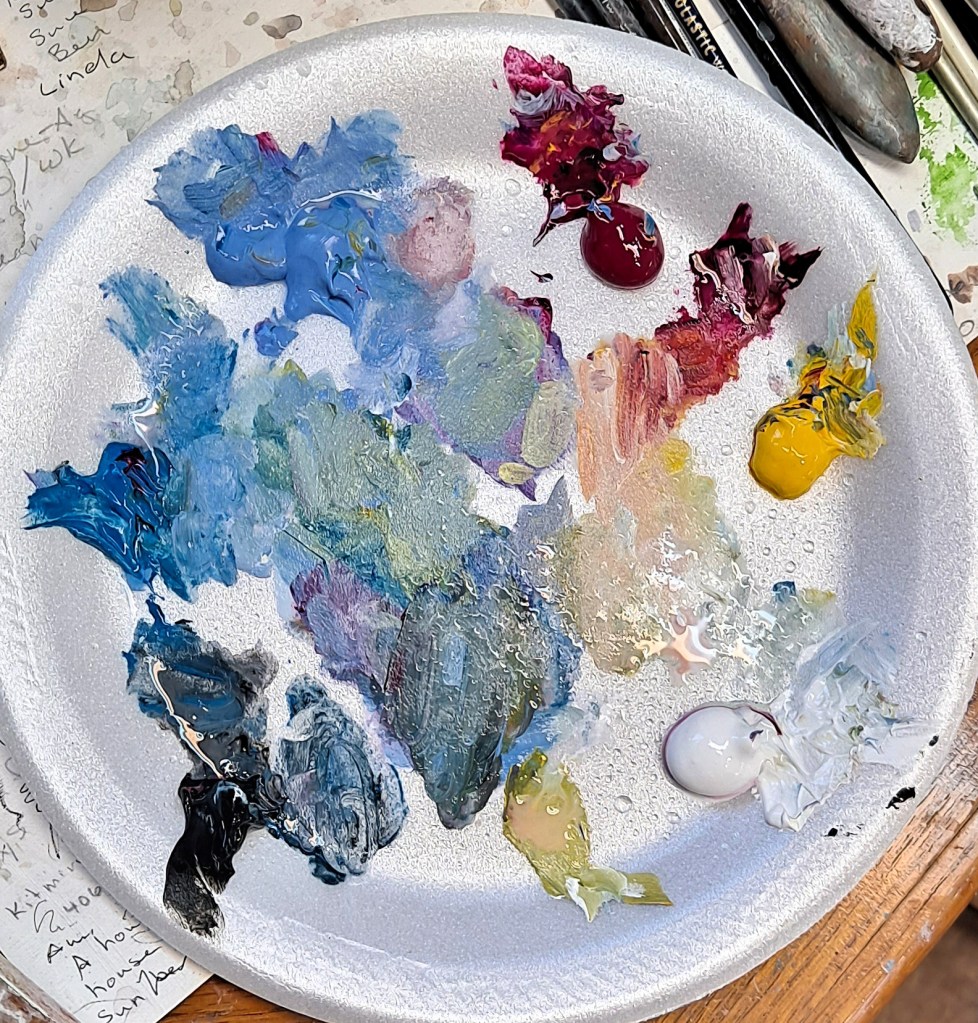
The most recent paintings that I’ve done have been with using a very limited palette which I’ve posted about previously. I’ve now cut the number back to four colors plus black and white. I like the challenge to see if I can adapt the most colors from just a few options. Actually, it works very well.
The original reference photo. I like the dappled light.
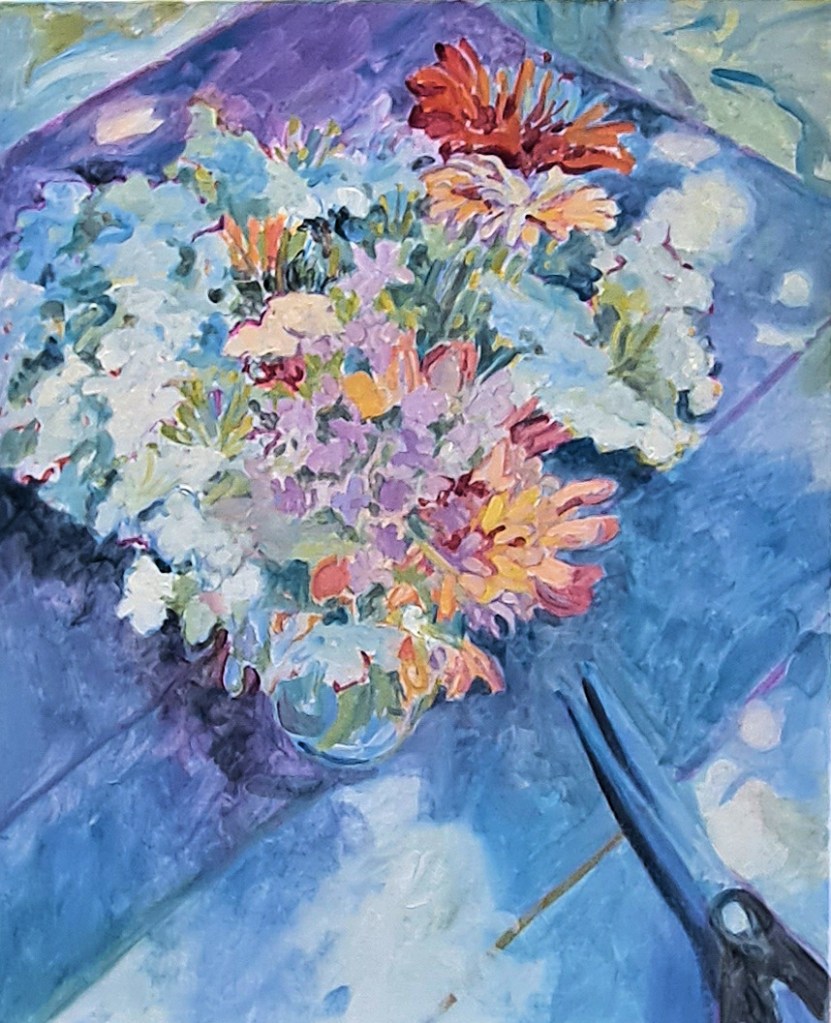
This painting is based on some photos that I took of summer flowers several years ago. Called August Bouquet, it showcases some zinnias and Queen Ann’s lace, plus others. The vase is sitting in the shade on an old wooden table, with dappled sunlight showing through. I’ve added some scissors as a foil for the flowers.
Vertical canvas prepared with thin color washesCanvas with sketches, and colored outlines
The canvas is a 20 x 16 vertical, 1.5 inches deep. I’ve already sanded and gessoed it and added a little texture. Then I added a thin wash of colors approximately where I anticipated locating the main shapes. After this coat dried (working with acrylics that only takes about twenty minutes), I then made a loose pencil outline of the flowers and other shapes.
The next step was to add color to the outline. I don’t try to make the outline colors match the subject, in this case, flowers. In fact, I often choose what I anticipate are contrasting colors to the final painting.
Middle stage with some fill-in color, loosely painted. I actually like this stage best. I think it would look nice in a larger size.August Bouquet, almost finished. I did not stick with the dark brown of the wooden table but kept to a lighter tone. I will tweak it a bit and add some gold or silver leaf details. Maybe.
Then the main shapes began to get filled in. I hesitate to call this the tedious part, but it is much more involved than the previous steps. I just have to stick with it until I’m done. I zone out, listening to music or a recorded book. Sometimes I fill in the background first; sometimes I start with the main subject. There are no hard rules here.
Canvas on my easel. I’ve turned off the painting light to get a better idea of values and colors. You will also notice a couple of shed snakeskins hanging on my easel. Actually, this is ONE snakeskin (about five ft) which my son found in the woodshed. He thought it would be fun to leave it for me in my studio…spread out on the floor. Big joker, eh?
I step away from the canvas often at this point to compare values, colors, shapes. The painting light above my easel can cast light which is too harsh so it’s best to turn it off while I compare values. This is a good point to take a break, perhaps overnight. I’ll often run out to my studio in the morning to see if the painting looks as I thought I left it or what glaring changes I need to make.
Although August Bouquet will be finished with a few more details, plus probably some addition of gold or silver leaf, I actually like one of the middle, less-finished stages best. One doesn’t actually need to put in every detail; in fact, it’s often distracting and doesn’t help convey the message of the painting.
Maybe I’ll paint it again with a less-finished look. What do you think?
My notes with a list of the colors I’ve used. All Liquitex or Golden Heavy Body Acrylics. These paints are high quality and thicker than standard paints. I can get more texture with them. My disposable palette with the four colors plus black and white.
Posted onNovember 7, 2023|Comments Off on Feature article in Southern Indiana Living Magazine
My work is featured in the November- December issue of Southern Indiana Living Magazine. Thanks to the wonderful write up by Judy Cato, she’s managed to condense forty years into two pages – with pictures! Thanks so much, SILM and Judy. Check it out here, pages 18-19.
I'm a professional artist, retired director of a performing arts center, bona fide book addict, and enjoy the quiet life...most of the time. I'd love to hear from you or get your ideas for future posts. Come back soon!








 I'm a professional artist, retired director of a performing arts center, bona fide book addict, and enjoy the quiet life...most of the time. I'd love to hear from you or get your ideas for future posts. Come back soon!


 my90acres