Tag Archives: art

How to set up a still life

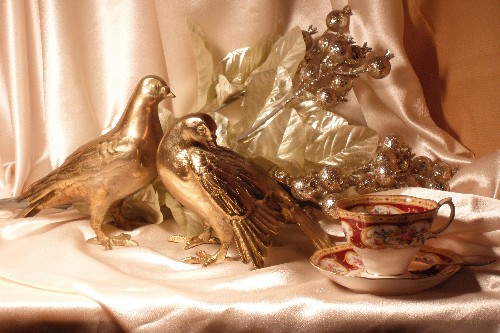
Final set up. Cup with silver spoon. Fixed silver foliage later.

It’s not always easy to set up a still life for painting.  It’s much more than just throwing a random collection of stuff on a table.  Check out my page for How to set up a still life for a photo story of one of my recent works.  I’ll post the painting later.

Open Studio Sale

You may have wondered where the heck I’ve been the past few weeks.  The truth is that I was preparing to have an open studio sale.  This is where you invite your friends, former patrons, even the public in general to come to your studio to buy some really great artwork at some really great prices.  In other words, to relieve you of the crap you’re stumbling over all the time. 

It dawned on me this summer that I can’t keep creating paintings without moving some of them out the door.  I used to do several art fairs a year and was pretty prolific at making work for sale.  Since I’ve had a full-time job for the past several years, I don’t have the opportunity to get out in the public to promote and sell my work.  Yes, I still do exhibits once in a while, but it’s difficult to sell the work and hold the job.  So…..

After being totally fed up with tripping over boxes of paintings, I decided that it was time to have an open studio sale.  I haven’t had one in several years so it took some planning and organization.

Generally I like to have the sale in the fall, well before the holiday season.  If you wait too late, then everyone is busy.  Autumn is pretty in my part of the world and everyone is still relaxed enough to enjoy a ride to see the trees.

I had my sale on October 20th but began promoting it at least six weeks earlier and planned for it even earlier.  I designed postcards, mailed them out to about everyone I could think of locally or within an hour’s drive.  This included co-workers, relatives, friends, patrons…just about anyone I could think who might be interested.  I mailed out about 160 postcards and gave away many more.  I promoted it heavily on my Facebook page, too.  The general rule of thumb is that 40% of the people you invite will come and about 20% will buy.  I’ve found that about 25% of the people I invite will attend but 95% will buy.  Nearly everyone bought multiple paintings, too.  It was a very good day.

I’ll add my back time list here soon, but generally, you need to plan back from the time of your event.  (This is what I do for my full-time job so it’s pretty natural to me.)  I began telling everyone the date as soon as I set it, even though I didn’t formally send out my postcards until about six weeks early.  Clean your studio.  Make your inventory.  And price your work as if you really want it to MOVE.  I put fire-sale prices on my work.  Yes, this was way cheaper than I would normally sell the paintings, but I asked myself, how much longer do I want to keep moving these around?  Also, there is the matter of stored paintings not being in the best conditions.  Do you want to let them sit there and mildew or do you want someone to actually put it on their walls and enjoy them?  I chose the latter.  Some people got some really great deals.  But I got a lot of cash and lots more space.  😉  Works for everyone.

I will note one thing is that I didn’t put everything I have created for sale.  I kept back my best or newest work.  Most of the work I sold were older pieces or what I call my practice pieces.  These included many of my plein air pieces, too.  So now I can buy more art supplies to create more paintings!  Yeah!  I also recommend actually removing your best pieces from your studio as I had people digging through my storage of things I didn’t even have out for sale.

In general, this is what I do for an Open Studio Sale.

  • Plan ahead, set your date at least three months out.
  • Create, order and mail your announcements.
  • Clean and organize your studio; decide exactly what you want to sell.
  • Create your inventory list, be realistic about rock bottom. prices….really, how much longer do you wish to look at this work?
  • Plan for some food.  I do homemade minnestrone soup, bread, cookies, and lots of wine.
  • Get some help the day of the event.  Enlist a friend, spouse, or child to help greet guests, wrap paintings, write up sales or restock supplies.
  • At the end of the day, have a glass of wine (or two), sit back and enjoy the warm glow of all the people who love your work enough to buy it.
  • Update your inventory list.  Mail thank you notes.  Get ready for more fun.

I’ll come back soon to put up my actual check-off list. 
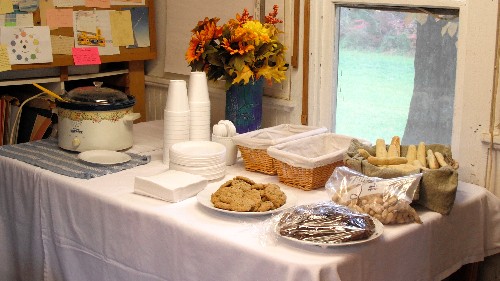
Good food and beverage is always an enticement. The wine and coffee were outside.
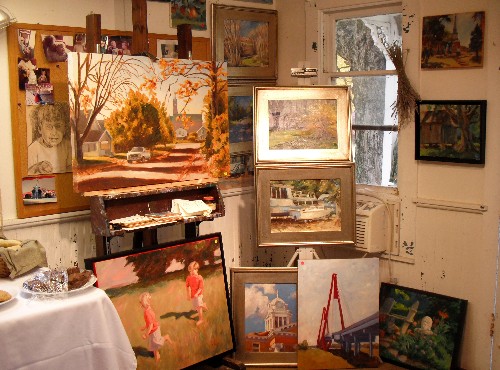
Display in the front studio.
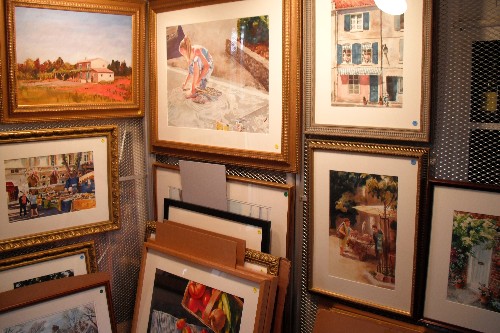
Display in the back studio. Notice the extra light. That really seemed to help.
How to combine watercolor and a pen and ink drawing

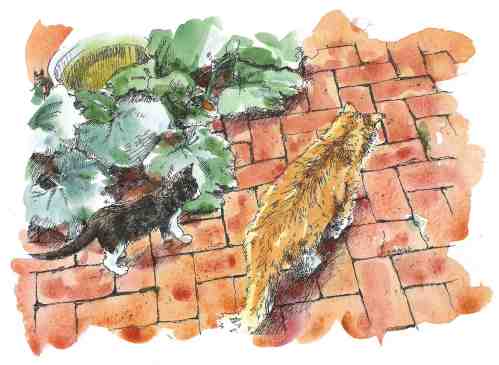
Cats at Grandview, watercolor over printed pen and ink

Recently I received a phone inquiry from a young man in New Jersey about how to apply watercolor to a pen and ink drawing.  Basically I have done this two ways.

One way is to do a pen and ink drawing , then add the watercolor on top of the drawing.  In this case, you must first make sure that the ink is waterproof.  I like to use traditional India Ink with a dip pen.  But there are also several waterproof, fadeproof pens that will work well for this.  The ones that have worked best for me are:  RoseArt Superview, Uniball Deluxe, Uniball Vision Elite.  I have tested these in the direct sunlight of a south-facing studio window and they have held up without any fading for at least ten years.  Some that have NOT worked well are the Zeb Roller and the Sharpie Fine Point. 

I use a rag watercolor paper, either cold press or hot press, of at least 90 or 140 pound weight.  After I draw the sketch, I let it dry at least a day to ensure that it won’t lift at all.  Then I paint over the top.  See the examples.

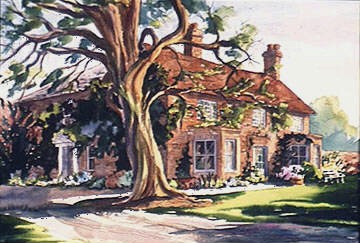
The second way to combine watercolor with pen and ink is to do the watercolor painting first, then add the details with the ink on top.  I used this technique for years when I created house portraits for clients.  I would first do a pencil sketch, paint the picture, then add the ink.  This allows the artist to paint very loosely and then add details which seems to be very popular with clients.

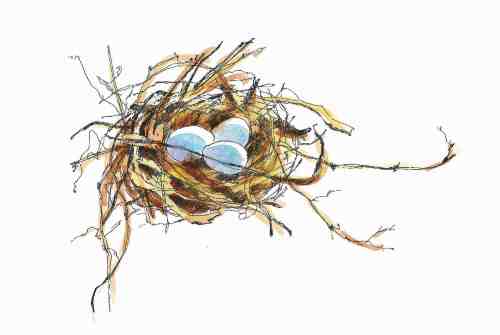
Nest, pen and ink printed, watercolor added

One neat technique is to scan your plain ink drawing into your computer, then print it on watercolor paper with black ink.  Then you can paint on top of that with watercolors after it has totally dried and set.  Allow at least a day for this. This only works with the black printer ink which is archival.  Again, I have tested this in my studio window and it has not faded in ten years.  To do this, you will have to trim your paper to fit through your printer and only use a weight that will go through the printer, probably 90 or 140 pound paper.  You’ll have to test this with your own printer.  Do NOT try to do this with the colored inks from your printer as those will definitely fade over time.  Again, I have tested this.  I have only used this with a regular home HP printer.  If you have access to a full-size art printer, you will have to run your own tests.

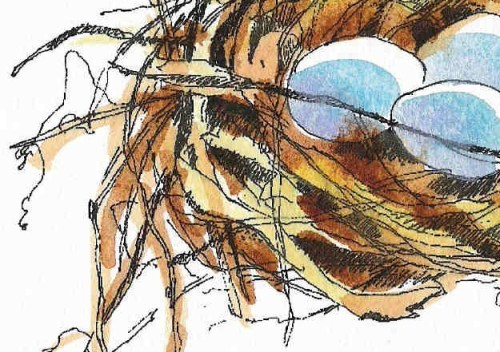
Nest, detail

Using the latter technique will allow you to scale your drawing to many sizes and is especially nice for note cards, postcards, and small works on paper.  I am also assuming that you are using only high quality, non-fugitive watercolors.  As a side note, nearly any watercolor will fade over time so they should never be exposed to direct sun for long periods of time.

I welcome any comments or questions about using this technique or any others that I have discussed in this blog.

How do you know when your painting is finished?

How do I know when my painting is finished?

That is a question I often ask myself.  For me, the answer is when I can’t think of one more thing to add.  Then STOP!

I’ve noticed that when I’ve taught a class, particularly a watercolor class, that sometimes the participants keep messing with their paintings until …well, they’re a mess.  Stop!  In the case of watercolors, leave some white space.  Leave some space, period.  When I’m working in oils, that is a little more difficult but I always try to avoid the overworked look.  With oils, I stand back and just LOOK.  It seems the closer I get to the final product, the more time I spend looking.  Sometimes it is even best to put it away for a while.  That advice is often offered to young artists but it’s true.  Sometimes after you’ve come back to your work with a few weeks off, the errors will jump out at you.  Other times, you’ll realize that you’ve nailed it.

I ask myself, what am I aiming for?  What is my message?  Despite painting in a realistic style most of the time, I am not aiming for anything approaching photo realism.  If you want it to look like a photo, then take a damn picture!  I’m looking for the message.  What struck me most about this subject?  What am I really trying to convey?  When is enough enough?

Wolf Eyes, detail, oil on canvas

This is a close-up view of a painting that I’m working on right now entitled Wolf Eyes.  I’m just about at the point where…there’s nothing left to add.  Time to set it aside for a while.  I’ll put it on my website when do finish it.  The message that I’m shooting for is the young man in his prime, he is oozing with virility and he knows it.  Wolf Eyes.

Using a limited palette in oil painting

Limited palette: Clockwise from Titanium White, Cerulean Blue, Cobalt Blue, Alizarin Crimson, Cad Red Med, Burnt Sienna, Cad Lemon, Naples Yellow

If you have been tempted to load up on all the pretty colors when you visit the art supply store, don’t give in.  You can create nearly any color from a limited palette.  Most experienced artists find this gives their work greater cohesiveness.  Learn more on my How To page by following the link.  https://my90acres.com/artwork/using-a-limited-palette-in-oil-painting/

Plein air painting at Monkey Hollow Winery today

Monkey Hollow Winery

Monkey Hollow Winery, 11 x 14 oil

I went out to Monkey Hollow Winery today with the plein air group, Runaway Artists (www.runawayartists.com).  If you’d like to see  the painting demo, again on a toned canvas, click on the link to take you directly to the page.

https://my90acres.com/artwork/plein-air-at-monkey-hollow-winery/

How to paint on a toned canvas

Does a blank canvas intimidate you?  Learn how to paint on a toned canvas. You’ll be surprised how this will speed up your painting and add an overall cohesiveness.  https://my90acres.com/artwork/painting-on-a-toned-canvas-step-by-step/